
The City of Edessa By Bernard Gagnon Courtesy of Wikipedia
Our Posts–Education, Faith, and Feminine Spiritual Transformations

Joan of Arc by the Author via Generative AI
Every topic we’ve explored—economics, faith, women’s financial autonomy, the politics of truth—has really been a study in memory. Who remembers. Who forgets. Who gets written into the story of a nation, a family, a church, an economy. And who has to fight to be seen. At its core, this work is about how memory shapes identity, and how identity shapes the choices women make in a world that is always negotiating power. Truth is one of the most powerful forms of currency.
What looks like separate topics between economics, Catholic spirituality, women’s financial literacy, truth and transformation, has always been one conversation. We’ve been studying the point of convergence: where memory becomes identity, where identity becomes history, and where history becomes story. At that crossroads, women make choices that reveal who they are and what they believe. This is the terrain where truth is chosen, not inherited. Therefore, when you understand the world, you can make choices in it. Also, there are so many women that have been martyrs and leaders, and they go unnoticed and unwritten about today.
Edessa, Upper Mesopotamia, St. Barbea

Convergence is the moment when spiritual truth, political pressure, and personal identity collide — and the choice you make reveals who you are. Few places in the ancient world embodied this collision more fully than Edessa. Born from the collapse of empires, it rose on a fault line of history a frontier city where Arab kings, Roman legions, and Persian armies contested not only territory but allegiance. Perched between worlds, Edessa functioned as both buffer and battleground, a place where control depended less on walls than on the loyalty of its people. Shifting between Parthian, Armenian, and Roman rule, the city learned early that power here was provisional: armies could occupy its streets, but belief determined whether authority endured. January 29th is the feast day of St. Barbea who is honored here today.
Saint Barbea of Edessa: Holding To Conviction
Saint Barbea of Edessa was an early Christian martyr from Syria, remembered primarily for her courage during the persecutions under Emperor Trajan. She was the sister of Saint Sarbelius and was converted to Christianity through the influence of Saint Barsimeus, a prominent Christian leader in Edessa.

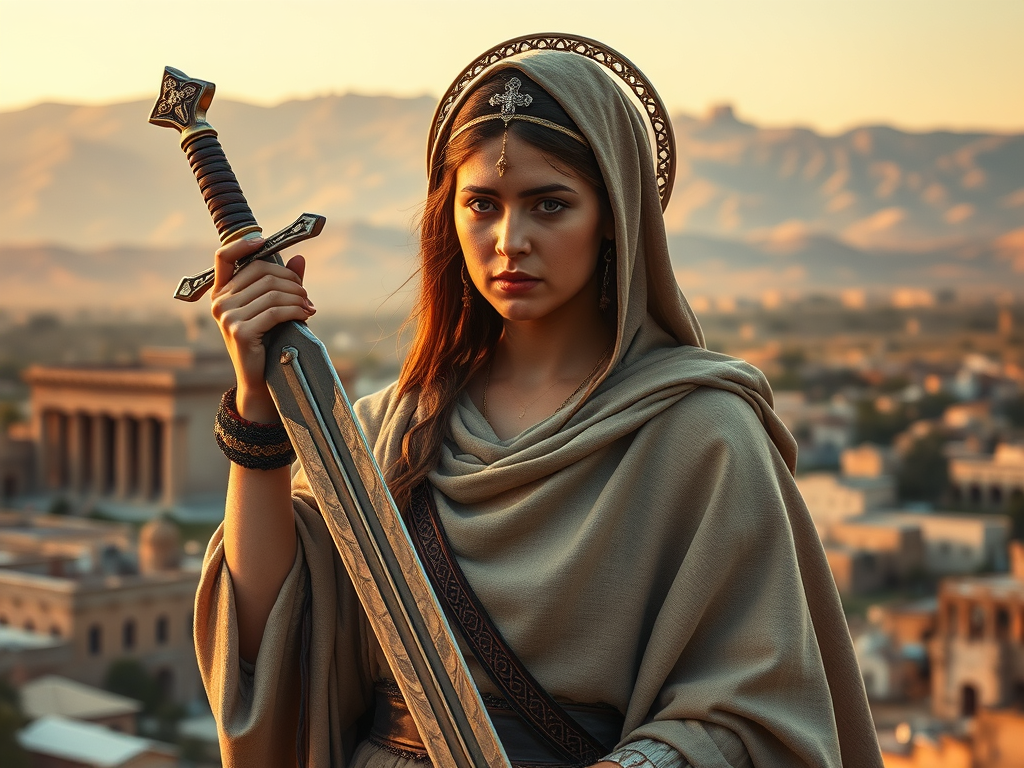
St. Barbea image by the author via generative AI
Once she embraced the faith, Barbea practiced it openly despite the intense hostility toward Christians at the time. Her refusal to renounce Christ led to her arrest and brutal torture. According to tradition, she endured:
- burning with hot irons
- severe scourging
- and ultimately death by spear
Throughout these ordeals, she remained unwavering in her devotion.
Barbea is considered a pre‑congregation saint, meaning her veneration predates the formal canonization process of the Catholic Church. She has no specific patronage or iconographic symbols associated with her, but her legacy endures through the commemoration of her feast day on January 29. She is honored as a model of loyalty, courage, and steadfast faith, especially among those who look to the early martyrs for inspiration. Her story stands as a testament to the strength of conviction and the power of belief in the face of persecution.
Epistemic Memory
This is interesting because where your epistemic memory is matters. I included this in my graduate school thesis, and I will share it here on the site. It is all about memory and story and it is key to any people’s and nation’s survival.