Posted on Leave a comment

#TIH: The Convergence of Truth & Memory St. Barbea of Edessa, Upper Mesopotamia

The City of Edessa By Bernard Gagnon Courtesy of Wikipedia

Our Posts–Education, Faith, and Feminine Spiritual Transformations

Joan of Arc by the Author via Generative AI

Every topic we’ve explored—economics, faith, women’s financial autonomy, the politics of truth—has really been a study in memory. Who remembers. Who forgets. Who gets written into the story of a nation, a family, a church, an economy. And who has to fight to be seen. At its core, this work is about how memory shapes identity, and how identity shapes the choices women make in a world that is always negotiating power. Truth is one of the most powerful forms of currency.

What looks like separate topics between economics, Catholic spirituality, women’s financial literacy, truth and transformation, has always been one conversation. We’ve been studying the point of convergence: where memory becomes identity, where identity becomes history, and where history becomes story. At that crossroads, women make choices that reveal who they are and what they believe. This is the terrain where truth is chosen, not inherited. Therefore, when you understand the world, you can make choices in it. Also, there are so many women that have been martyrs and leaders, and they go unnoticed and unwritten about today.

Edessa, Upper Mesopotamia, St. Barbea

Convergence is the moment when spiritual truth, political pressure, and personal identity collide — and the choice you make reveals who you are. Few places in the ancient world embodied this collision more fully than Edessa. Born from the collapse of empires, it rose on a fault line of history a frontier city where Arab kings, Roman legions, and Persian armies contested not only territory but allegiance. Perched between worlds, Edessa functioned as both buffer and battleground, a place where control depended less on walls than on the loyalty of its people. Shifting between Parthian, Armenian, and Roman rule, the city learned early that power here was provisional: armies could occupy its streets, but belief determined whether authority endured. January 29th is the feast day of St. Barbea who is honored here today.

Saint Barbea of Edessa: Holding To Conviction

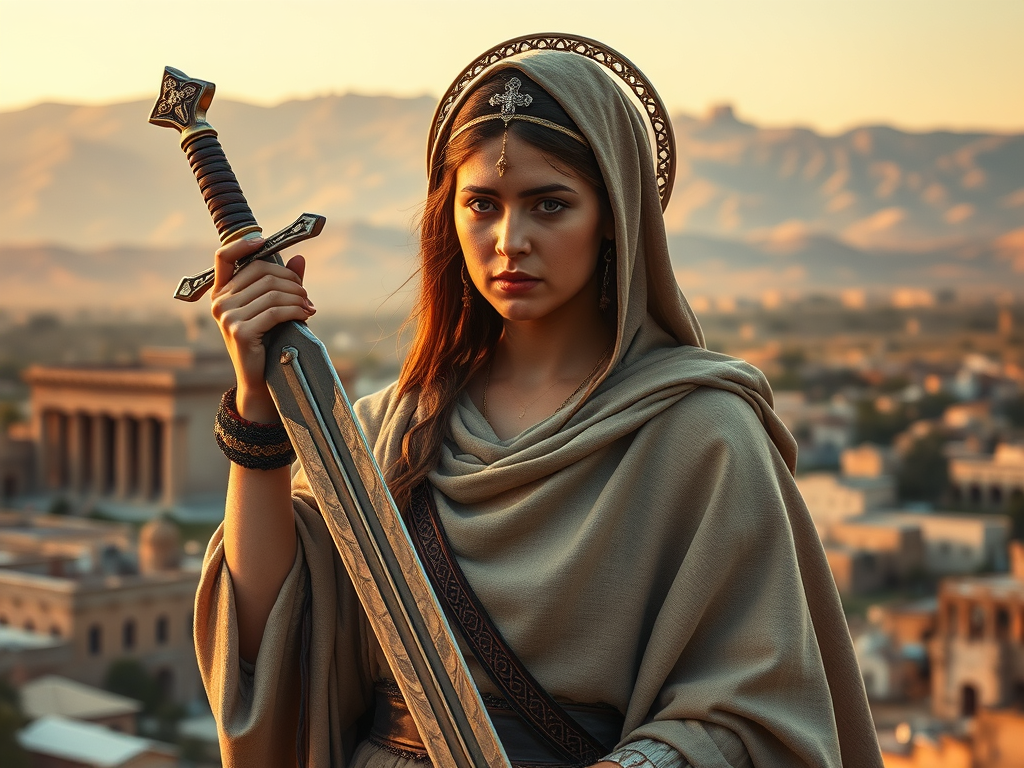
Saint Barbea of Edessa was an early Christian martyr from Syria, remembered primarily for her courage during the persecutions under Emperor Trajan. She was the sister of Saint Sarbelius and was converted to Christianity through the influence of Saint Barsimeus, a prominent Christian leader in Edessa.

St. Barbea image by the author via generative AI

Once she embraced the faith, Barbea practiced it openly despite the intense hostility toward Christians at the time. Her refusal to renounce Christ led to her arrest and brutal torture. According to tradition, she endured:

  • burning with hot irons
  • severe scourging
  • and ultimately death by spear

Throughout these ordeals, she remained unwavering in her devotion.

Barbea is considered a pre‑congregation saint, meaning her veneration predates the formal canonization process of the Catholic Church. She has no specific patronage or iconographic symbols associated with her, but her legacy endures through the commemoration of her feast day on January 29. She is honored as a model of loyalty, courage, and steadfast faith, especially among those who look to the early martyrs for inspiration. Her story stands as a testament to the strength of conviction and the power of belief in the face of persecution.

Epistemic Memory

This is interesting because where your epistemic memory is matters. I included this in my graduate school thesis, and I will share it here on the site. It is all about memory and story and it is key to any people’s and nation’s survival.
Posted on Leave a comment

Just The Facts: Whoever Controls The Media, Controls The Mindset Of The Masses, Therefore Ethics And Neutrality Should Be The Mainstream News’ Mainstay

Daily writing prompt
What’s something you believe everyone should know.

A lot of people are up in arms about the Washington Post’s recent decision to not endorse a political candidate. However, I have to admit, I never liked the idea of mainstream media endorsing candidates, due to its sway over the masses. Malcolm X spoke about this power of the media to make the “innocent guilty and to make the guilty innocent.”

Now, in fairness, we depend on the news media to hold themselves to a high standard of journalistic integrity. But, with money as a strong influence behind the scenes, many wonder if that’s possible. Especially when there are bills to be paid and doors that need to be kept open for employees. But we are not ignorant of the power of media in all its forms. I am very familiar with the power of influence and the effect it can have on one’s life. I watched one influencer for ten years straight. She was mom and she had several failed relationships and she was always chasing a dream and a dollar. She was very beautiful, very vulnerable, and a stay at home mom like me at the time. I resonated with each crying spell and homemade fried chicken enchilada. But, the more I watched her, the more my life mirrored hers. I was slowly becoming a volatile red-lipped mess yelling at my kids to clean, and dreaming of dreams that I wasn’t working towards.

That is the power of influence and the reason I pay more attention to what I consume. You should too. It’s not easy, but it’s worth it. Remember, not only are we who they say we are, but we become what we focus on. It’s the reason I thought long and hard about the importance of sharing the problems, but highlighting the solutions of our world.

Plato once said that, “those that are able to see beyond the shadows and the lies of their culture, will never be understood, let alone believed by the masses.”

I have personal experience with being ahead of my time. It kind of forces you into a corner or the outskirts of your social circle. No one has the time or the capacity to think too deeply, too long, or too hard–and it’s an exhausting endeavor to be believed. But, I feel that change is coming. Who other than the news media, the most powerful entity in the world, should bare the responsibility of being factual and neutral? We are reliant on those overseeing our information to be fair, just, non-biased and balanced. Now, the people who work at institutions have opinions and they should, but they shouldn’t make it to the media.

One of the reasons that we are in a free speech battle and many other societal battles at this time is because we have given freedom to the masses without parameters and ethics”–Luz

Yet when you think about the press and why people start them up, (myself included) it happens because you feel either misrepresented or overlooked. We do this because of those words imparted by Plato and Malcolm X–we need control and representation! You may feel that major outlets aren’t covering your issues. That’s a fair assessment as well. But, one of the reasons that we are in a free speech battle and many other societal battles at this time is because we have given freedom to the masses without parameters and ethics. I am largely speaking in the realm of journalism but you get my point.

Therefore in my opinion, major news outlets should not endorse candidates. They should remain objective and allow the people to make their decisions. Now, concerning the onslaught of misinformation administered by citizen journalists, and bloggers focused on entertainment operating with or without ethics, only reinforces the necessity of major news outlets being the standard-bearers of neutrality. In doing so, it serves as a form of checks and balances in the realm of reporting and influence. In my opinion, it was the right thing to do, and strong move for helping skeptical readers regain trust in their information sources.

What do you think? Should mainstream newspapers endorse candidates or lean heavily into religion?

Leave your thoughts in the comments.

Posted on Leave a comment

The Power of Your Vote

Written By: Chiara Atoyebi

Daily writing prompt
Do you vote in political elections?

I learned about the significant impact history had on our voting decisions while I was an incoming freshman at the University of Michigan. I still can recall the first time I cast my ballot for president. I remember innocently walking to the polling place, excited to cast my vote, when a classmate casually asked me, “So who are you voting for?” Back then I didn’t know that this type of question was generally taboo and gave my honest answer. I was considering voting Green. 

My friend looked at me a little bit shocked, “nah, nah,” he laughed. “You gotta vote this way. Everyone is voting for this person.” Although I thought it was strange to not vote for the issues aligned with my convictions, I followed the rules and cast my vote as I was encouraged to do so.

How many of you have experienced the same kind of cajoling into a position that would ultimately solidify your voting direction throughout life? This is not uncommon, especially among minority groups whose existence and socio-economic progression depend on a majority rules stance–i.e. Groupthink. 

According to an article in Very Well Mind, Groupthink is defined as, “a psychological phenomenon in which people strive for consensus within a group. In many cases, people will set aside their own personal beliefs or adopt the opinions of the rest of the group. The term was first used in 1972 by social psychologist Irving L. Janis.”

 While I have never missed the opportunity to vote in any election since I first became of legal age, I am becoming increasingly focused on my state and local elections due to their direct impact on my life. We often hear are issues being “state’s issues” but many lack the knowledge of who their local representatives, are and what they do.

It’s my personal belief that the highest office should focus on issues that are large in scale: infrastructure, terrorism, war, the national budget, and our military to name a few. If my state has the authority to overrule certain issues and deem rulings ineffective, then my local electorate becomes the focus. Consider this–every elected official in your state should be acutely aware of what is happening under their stewardship. If they’re not, then we have a problem. Certain matters should not be limited to the White House’s sphere of influence alone but instead should be further expounded upon by subject matter experts.

Our nation is having a come-to-Jesus moment in terms of our relationships with government, authority, and established systems. 

Photo by Element5 Digital on Pexels.com

It has been reported that many people will not vote. This can be attributed to the recent lesser of two evils discourse surrounding the presidential race, as well as our inherent GroupThink mentality.

Some people’s lack of civic engagement stems from outdated ideas and loyalties they believe will carry them through until their party re-aligns with their interests.

It’s a valid option. Changing things from the inside out is sometimes the most effective way of doing business.

I know the cost that was historically paid for me to cast my vote. Despite what I may feel, and even if I seemingly go rogue at some point, I will always cast my ballot. 

Every day, hundreds of decisions get made in the interest of minorities and are supposedly for minority groups, delegated by people who have an intellectual assessment of the situation. 

Simply put, that is because we are not in the room. We need to be in the room and where we can’t be in the room, our vote has to be. 

Moreover, I encourage you to get involved with local politics. Know who is on your school board, know who is regulating the food in your area, and what new programs are being put into place.

Here are some resources for you to get involved locally: 

American Local Government Elections Database 

Find and Contact US Elected Officials

List of State Secretaries