Posted on — Leave a comment

Learning How To Vote

How have your political views changed over time?

Over the past few days I took a break on social media in order to spend some quality time with my family watching movies. I am very into inspirational movies that have a lot of high drama and then wrap up with a happy ending. I must admit, I am a sucker for love and a hopeless romantic.

I watched a really crazy one called The Kept Woman, that I felt I needed to be rescued from. There was so much symbolism in there that was clearly inferencing conservatives vs liberals in a tongue in cheek, Norman Bates meets Laverne and Shirley type of way. The not so subtle politics of it all got me thinking.

An Interesting Politiview

I used to secretly call myself a liberal traditionalist. It’s a name I coined which means, I believe in tradition for me and liberal values for you, if you chose them. But, as a law professor I worked with once said, “you just want to do what you want and have someone else pay for it.” I’d never thought of it that way, but I plead the fifth to that statement. I’ve given this statement a bit of thought over the years and have come to the conclusion that it’s basically a common sense moderate. 

When I turned 18 and was finally able to vote I was an environmental girl. It made sense that I was planning to cast for the Green Party yet I clearly remember being told by a classmate at the University of Michigan that “we” were all voting blue. So I voted for President Clinton, and I didn’t give it much thought because I was not fully invested in politics. Like lot of young people I was concerned about rushing, partying, going to classes and dating. Also, I thought he did a great job. I don’t regret voting for him. My money looked great at the time he was in office. I mean, what was not to love?. I’ve since learned that life is more nuanced than that and I know many people had a fair amount of complaints during that time.

During those years, I was very much into my church. Although I occasionally went to mass by myself, I considered my church home to be the non denominational church, Word of Faith. I was very into my church sorority/fraternity on campus and they thought differently about politics. I simply assumed that my pastor was a Democrat. I learned later that he was not. He was the person that advised me to stay in school and then pursue my acting dreams and I’d be blessed. I wish I listened. I went my own way, only to come back to what he said, and finally get back on track.

In college I was close with his daughter as well. We lived in the same dorm and she was a good friend and even mentor. They were a family strong on family values and adamantly against abortion. At the time, it was not a big deal for me. Again, I was against it, but I also didn’t feel that connected to the issue. I didn’t know anyone that had one. I didn’t plan to get one and I figured that it would all take care of itself. This is the mindset of a lot of wait and see individuals.

I also regretfully condemned people on other issues. Those typical Christian arguments about not being fully submitted to God or who drank alcohol. Ironically, as I began to enter the Feminist arena later in life I took the simple stance of women being equal. Equal pay, equal opportunity, etc. That was until I learned about the movement during the 19th century and the role of African American club women. LThese highly privileged women did not resonate with me at the time, but they would later in my life. They share my values and beliefs and their ideas of advancement work in tandem with men. Yet, I still remained dissociated from my politics, like a lot of people, because I figured it would all work out by the hands of “they/them.”

At some point, that changed. When I grew deeper into my faith as a Catholic, I did not become political but I did have a fire lit for life and service. I also began to think logically about how a non profit could help, or my challenges and losses could benefit others, and myself. Additionally the trials of Women in the Bible inspired me and their stories are not always spoken in the way I’d like to see them. They are juicy, controversial and powerful—they are the blueprint.

I hate to pit one value against another politically because ideally we should all be independent. We should embrace the ideals of charting a new course while giving a portion to those that need it and who are finding their way.

I have spent the last year continuing to create my own new plan. I had to take a step back to take a step forward. I kept asking, “Lord what is your will for me?” Even if it is slower going, I believe when we are given a vision it is to be carried out.

This vision changed how I see things politically. As an entrepreneur, how am I best served? I know that as a person, I will help others. But how can I be in a position to do that? What are my beliefs around food and medicine? Who is aligned with what I actually believe? For many of us, the area is gray. But who is that?

I am not the first to say it, nor would I be the last, but we are more alike than we are different. Which is why we focus on issues that are more personal and make them grand scale. Government should focus on major issues that are often out of our control. They shouldn’t be like a helicopter parent telling us how to live our lives. However, there are times when it has to be. This is unfortunate because we continue to slide back into rhetoric that pulls us back and causes us to behave in a way that is detrimental to our societal civility. I want to be where the rhetoric is for all. Where I feel uplifted and not like a fool. I want to feel like I am moving forward and not stuck and where my difference is ok.

The very thing that makes this country great is its diversity. No one should be minimized or should minimize themselves. If you carry the light of the world in your heart, you don’t want to see anyone abused and downtrodden. It’s like a marriage.

A Marriage of Opposites

In my marriage I used to say, let’s try to give each other the benefit of the doubt. Let’s see the good in each other instead of clinging fast to the negative narrative. The truth is being told to you, right here and right now. Can you see it? Yes. But sometimes it’s hard to feel it. We want to feel the difference and that’s harder.

Friends, I have to be honest. My ideas often did not get through. In a marriage of complete opposites and beliefs in every way, agreeing is struggle on all levels. However, through that lens and challenge came an understanding that for some people it is harder to have them see a new way. Their heart is hardened from hurt and disappointment. They may never recover or believe what they see. They want change but they want the comfort of knowing that the one in front of them is still the boogeyman—then they can be right.

This is also our political arena. So, for me faith is very important. You can do and say all that you want, but faith and hope are required for change and that is a spiritual design. That takes time.

I too suffer from my own limited beliefs. I can’t let myself off the hook entirely. You may be like this, “I believe in change and goodness, just not from you neighbor! You are a hopeless case.” Well, that is a little true. And we are all someone’s hopeless case. But the biggest rewards come to those who endure big challenges. Similarly, to take on the Feminist ideology of the personal is political, it all still holds true. Our lives effect our choices depending on the day. I’m also still green leaning. I believe compassionate people care about this earth. Caring about space and nature brings us into the magnificence of creation and a natural connection to each other.

In conclusion, I have changed only in the regard of me being aligned in an intentional and logical way when it comes to how I view politics.

Here are some things to consider:

Do you care about what happens to your immediate life or on a grand scale? Who makes those decisions?

If you are a new parent, changed religions, or identify with the LGBTQ community or have family that is incarcerated how does that affect your decisions?

If you are largely stable and you want as much of a melting pot with shared values within a pluralist society how does that affect your decisions?

These thoughts help to align us with our true selves and allow us to authentically negotiate what is right and true in our lives.

You may lose a lot following your convictions. I didn’t do anything radical but talk about my spiritual walk and it caused my world to crash down. However, that is ok. What is good still stands and old things continue to pass away. This too shall pass.

Stay strong. Stay focused.

Posted on — Leave a comment

Creating A Culture of Timeliness In An Increasingly Fast Paced World

Daily writing prompt
What’s one small improvement you can make in your life?

I don t know about you, but since the pandemic, I have seemed to struggle with time. Not necessarily time management when it comes to completing tasks but arriving at places in person on time. What makes it even more of a challenge is that I am pretty comfortable working remotely. Unfortunately, I don’t see myself, especially as an entrepreneur, making a permanent switch to working in person. I am of the mindset that more work gets done in isolation. Yet, I am venturing out again into the world socially, and on the outside, time does matter. Not everyone wants to stay within their own four walls forever. As I started going out more, I found that I was often met with closed doors and canceled reservations because I was late.

Monochronic and Polychronic Cultural Views of Time

Differing cultural views can have an effect on how we see time. In Western society, people are often judged on their ability to be timely. We tend to follow along with and thrive best within a linear, monochronic society. Linear thinking follows a straightforward, cause-and-effect pattern. It assumes that events progress in a predictable, step-by-step manner. Additionally, monochronic cultures like ours, value timeliness when it comes to work, structured workdays, and individual accountability. These characteristics are valued in employees as well as in leadership.

However, this highly structured work environment can create burnout in people. It can be rigid and devoid of flexibility, leaving people feeling discontent and searching for life’s balance. On the other hand, cultures that are polychronic, such as those in the Middle East, tend to have work environments that allow for interruptions, breaks, and social interactions. Employees may engage in multiple tasks simultaneously. While this style of interaction can promote relationship building and greater team focus due to flexible schedules, efficiency can become an issue. I can attest to the latter. Efficiency, takes on many forms and criticisms, especially in a society where productivity can be boosted by AI. I believe that although some work and even employees may not be as timely, as other hard-driving producers, they tend to bring a distinct value that is necessary. Think quality or quantity due to honoring the natural flow of life. We could place them in a category of non-linear thinkers. These individuals tend to take a more holistic viewpoint of life, seeing the system as a whole rather than just isolated parts – they are our creatives and visionaries.

Daily Life and Timeliness

My issues with time date back to childhood. I was the kid they had to move away from the window due to my lack of focus and incessant day dreaming. My parents were in the military and I while I was often punished for my lateness, it seemed to create an adverse reaction to rigid time restrictions in me. I became rebellious instead of focused. At times, I have found myself missing out on time with friends, my yoga classes, and even some important deadlines due to my causal relationship with time. Over the last six months I have worked diligently to get back on the wagon in regard to time and I am seeing great improvements. I still tend to display a Laissez fare attitude towards time every now and then, I have learned to slay this dragon by considering the time of others. When I am late, it also affects others, and that is not a good feeling. Additionally, when you’re on time you can casually walk into a building, orient yourself, and begin your day with ease. When you are late you are rushing, anxious and often wind-up apologizing.

The moral of the story is: Leave early, be on time, and consider yourself and others in the process.

Posted on — Leave a comment

She Said What? Decoding Sojourner Truth’s famous “Ain’t I A Woman Speech And Understanding the 1850s”

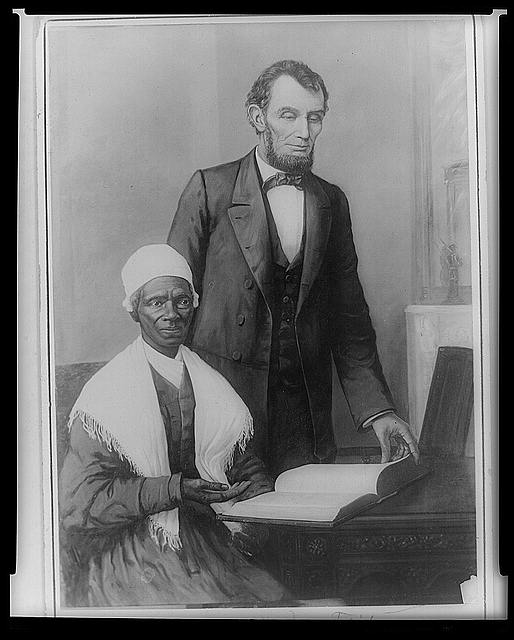
A. Lincoln showing Sojourner Truth the Bible presented by colored people of Baltimore, Executive Mansion, Washington, D.C. ca. 1893. Photograph.

“My name was Isabella; but when I left the house of bondage, I left everything behind. I wa’n’t goin’ to keep nothin’ of Egypt on me, an’ so I went to the Lord an’ asked Him to give me a new name. And the Lord gave me Sojourner, because I was to travel up an’ down the land, showing the people their sins, an’ bein’ a sign unto them. Afterwards I told the Lord I wanted another name, ‘cause everybody else had two names; and the Lord gave me Truth, because I was to declare the truth to the people.” (Harriet Beecher Stowe, “Sojourner Truth, the Libyan Sibyl,” Atlantic Monthly Apr. 1863, 478)

Sojourner Truth, also known as Isabella Baumfree, died on November 26, 2022. Her death had me thinking about the first time I heard her famous speech, “Aint I A Woman.” The interesting thing about history and conversations surrounding memory–is the grey area within the interpretation. For me, nothing can be interpreted fully without taking into account an individual’s sense of self and the psychological perspectives of the community at that time.

Historians have compared and proven the validity of different versions of Truth’s famous speech. Although there was no speech transcript during the convention, her remarks were recounted by abolitionists of the time. Truthfully, how they accurately created two full and different speeches from memory is impressive to me. Perhaps they took notes? Admittedly, something feels incomplete surrounding the information, and I will have to continue my research of the convention. 

However, my initial interpretation of the speech was that she spoke on behalf of her race and on aspects of her womanhood. The reality is that Baumfree was an African woman born into slavery and treated as if she was not a woman in the same way her White counterparts. I often wondered if her laments made subtle jabs at the system and the women around her. 

If the injustices of the past mirror the civil unrest and racial sentiments of today, it is understandable that Truth would convey her true feelings at the convention to some degree. In fact, this was a woman bold enough to run away from her enslavement.

Truth coming to the podium and stating Ain’t I Woman, would be a logical question placed towards people that had to be convinced of her humanity and womanhood. Moreover, it would all make logical sense considering the period of The Cult of True Womanhood (1820-1860) which raised White womanhood to virtue and purity, while subjugating Black womanhood to licentious stereotypes.

What if Truth’s baiting with the phrase Ain’t I A Woman, was her way of waking people up to her plight and the Truth of their own.

Woman’s Rights Convention, Akron, Ohio, May 28 and 29, 1851 

According to the official transcript of the Ohio Women’s Convention at Akron, that took place in 1851 it was recorded that Sojourner Truth commented on education. The purpose of this convention and several others like it, came on the heels of the 1848 Seneca Falls Convention, which fought for women’s social, religious and civil rights. Elizabeth Cady Stanton opened the convention with these words:

“We are assembled to protest against a form of government, existing without the consent of the governed—to declare our right to be free as man is free, to be represented in the government which we are taxed to support, to have such disgraceful laws as give man the power to chastise and imprison his wife, to take the wages which she earns, the property which she inherits, and, in case of separation, the children of her love.” –Elizabeth Cady Stanton, Seneca Falls Convention 1848


Stanton, Elizabeth Cady. Elizabeth Cady Stanton Papers: Miscellany, -1946; Biographical data. – 1946, 1840. Manuscript/Mixed Material.


The need to fight for women’s rights were agreed upon by all women. The only question was who would obtain the rights first. Looking at history and reading the thoughts of the women in attendance at the time, you understand the importance of accepting all people today. If not, you subject them to inhumanity.

You can read the transcript from the convention on the Library of Congress website here. It’ s very interesting and delivers a litany of obvious reasons and examples of a woman’s right to equality, her wages, and her inherited property. 

From The Sojourner Truth Project, you can compare the two speeches for yourself. Given the times, what do you think Sojourner meant? Which speech feels true to you?

Marius Robinson’s transcription:
Published June 21, 1851 in the
The Anti-Slavery Bugle

The oldest account of Truth’s speech that provides more than a passing mention of it was published by Marius Robinson on June 21, 1851 in the Salem Anti‐Slavery Bugle, a few weeks after the speech was given. This version was not the first published account of the Akron speech, but rather the first attempt to convey what Sojourner Truth said in full.

  1. May I say a few words? I want to say a few words about this matter.
  2. I am a woman’s rights.
  3. (a) I have as much muscle as any man, and can do as much work as any man.
  4. (b) I have plowed and reaped and husked and chopped and mowed, and can any man do more than that?
  5. I have heard much about the sexes being equal; I can carry as much as any man, and can (c) eat as much too, if (d) I can get it.
  6. I am as strong as any man that is now.
  7. As for intellect, all I can say is, (e) if women have a pint and man a quart – why can’t she have her little pint full?
  8. You need not be afraid to give us our rights for fear we will take too much, for we cant take more than our pint’ll hold.
  9. The poor men seem to be all in confusion, and dont know what to do.
  10. Why children, if you have woman’s rights, give it to her and you will feel better.
  11. You will have your own rights, and they wont be so much trouble.
  12. I cant read, but I can hear.
  13. I have heard the bible and have learned that Eve caused man to sin.
  14. Well if woman upset the world, do give her a chance to set it right side up again.
  15. The Lady has spoken about Jesus, how he never spurned woman from him, and she was right.
  16. When Lazarus died, Mary and Martha came to him with faith and love and besought him to raise their brother.
  17. And Jesus wept – and Lazarus came forth.
  18. And how came Jesus into the world?
  19. (f) Through God who created him and woman who bore him.
  20. (g)Man, where is your part?
  21. But the women are coming up blessed be God and a few of the men are coming up with them.
  22. But man is in a tight place, the poor slave is on him, woman is coming on him, and he is surely between-a hawk and a buzzard.

Frances Gage’s inacurate version:
23 April 1863 issue of the
New York Independent

The most common yet inaccurate rendering of Truth’s speech—the one that introduced the famous phrase “Ar’n’t I a woman?”—was constructed by Frances Dana Gage, nearly twelve years after the speech was given by Sojourner at the Akron conference. Gage’s version first appeared in the New York Independent on April 23, 1863. 

  1. Well, chillen, whar dar’s so much racket dar must be som’ting out o’kilter.
  2. I tink dat, ’twixt de niggers of de South and de women at de Norf, all a-talking ’bout rights, de white men will be in a fix pretty soon.
  3. But what’s all this here talking ’bout?
  4. Dat man ober dar say dat women needs to be helped into carriages, and lifted over ditches, and to have de best place eberywhar.
  5. Nobody eber helps me into carriages or ober mud-puddles, or gives me any best place.
  6. -And ar’n’t I a woman?
  7. Look at me.
  8. (a) Look at my arm.
  9. (b) I have plowed and planted and gathered into barns, and no man could head me.
  10. -and ar’n’t I a woman?
  11. I could work as much as (c) eat as much as a man, (when (d) I could get it,) and bear de lash as well
  12. -and ar’n’t I a woman?
  13. I have borne thirteen chillen, and seen ’em mos’ all sold off into slavery, and when I cried out with a mother’s grief, none but Jesus heard
  14. -and ar’n’t I a woman?
  15. Den dey talks ’bout dis ting in de head.
  16. What dis dey call it?
  17. Dat’s it, honey.
  18. What’s dat got to do with women’s rights or niggers’ rights?
  19. (e) If my cup won’t hold but a pint and yourn holds a quart, wouldn’t ye be mean not to let me have a little half-measure full?
  20. Den dat little man in black dar, he say women can’t have as much rights as man ’cause Christ wa’n’t a woman.
  21. Whar did your Christ come from?
  22. Whar did your Christ come from?
  23. (f) From God and a woman.
  24. (g)Man had nothing to do with him.
  25. If de fust woman God ever made was strong enough to turn de world upside down all her one lone, all dese togeder ought to be able to turn it back and git it right side up again, and now dey is asking to, de men better let ’em.
  26. Bleeged to ye for hearin’ on me, and now ole Sojourner ha’n’t got nothin’ more to say.