Posted on Leave a comment

Fiction Friday: Never Would I Ever

A chance meeting with a stranger could change your life forever.

Summer Mitchell wasn’t known for taking shortcuts, breaking the rules,  or doing much of anything really outstanding. Maybe she was known for her good looks, but like so many other things in her life, they were fading. At least she felt so. 

She’d largely spent her prime years being a mother, wife, and physical therapist. The latter fell by the wayside after she lost her daughter Amirah. After that, she just couldn’t seem to get it together. However, she was a really good physical therapist. At least that’s what her patients always told her when she was practicing.

It was tragic that she’d seemingly let it go forever. Although she sat with many regrets she chalked it up to the sacrifices of being a mother. Her kids loved her at home, and even her husband Darius didn’t want things to change. But, at some point, he realized if he wanted to see his wife smile again he needed to do something different. Little did he know all that had transpired as a result of his pushing and prodding her back into the workforce. They both knew it wasn’t because they needed the money, it was because he hated seeing her mope around all the time. The spark that drew her to him so many years ago had faded and he didn’t know how to get it back. Lately, it seemed like his efforts to get Summer motivated had worked too well. Ever since she went to that basketball game with Stephanie, she’d been a different woman. She was working longer hours and hanging out with her friend way more often than he could stand. Darius knew better not to question her or she’d blow up in his face and threaten to leave. He knew he was largely responsible for her outbursts, but he wondered if would it get better or was she gone forever.

***

Summer and Rob stood in the parking lot next to her truck after his game for what felt like the tenth time. It was a cool night, and she was not dressed for the weather. Most nights they stood staring at each other next to the car door or holding hands over the hood. This time was no different except, she was looking to make it come to an end. Every time she looked into his eyes, or he said her name, she felt like running away with him but–something kept stopping her.

“Talk to me,” he said. “Are we just going to stand here or are we going to my house? Talk to me. Or at least stand closer to me.”

His face was illuminated by the lights that hung overhead. Despite her best intentions, they were outside and out in the open. The energy was palpable, and they weren’t hiding. 

“You want honesty?”

He nodded slowly and licked his lips. Summer felt dizzy.

As she was about to speak a gust of wind blew her hair into her eyes. 

He stepped forward and carefully moved the strands from her face. 

“I should pull your hair right now,” he said. 

“I think I would love it,” she smiled.

They laughed. Clearly, they caught each other off guard with their honesty.

He squinted at her and folded his arms.  

“What do you want? Summer? Do yourself a favor and be honest for once in your life.”

“I want you,” she said stepping closer.  “I know I am horrible for it but, I think what I want is to love and support you forever.  I want to be led by you. I want to do what you say and follow you around this world forever. That’s what I want. That’s what I feel when I am next to you.”  She couldn’t believe she was talking like this; it just wasn’t who she was. 

His face grew intense. She saw his fists tense up against the hood. Something about those words leaving her mouth made him want to take her with him forever. She could forget her life, she wasn’t happy anyway. Unfortunately, he couldn’t do that. Despite what it seemed like to the few people he told about Summer, he had a code of ethics. He would never take a man’s girl. He would just force her to leave him.

“You really mean that? You think you want all of me Summer?”

“Yes.”

“I don’t know if you are ready.”

“I don’t know either, but trust me, I could handle whatever you put me through.”

She could hear him breathing. He reached out and pulled her closer.

“Come here.” 

She shook her head no. 

“Why?”

“Because if I take one step closer to you, I won’t leave. Rob, I meant what I said, but I also can’t do anything about it.”

“F-it then, stay with me. Why deny how you feel?” He pulled her closer and tried to give her a kiss. 

Summer put her hand on his chest in a weak effort to create space. Not that she could stop the electricity passing between them. Was this love? No, not like this. 

“Rob, I have kids.”

“Ok, ok, I get it” he sighed letting go of her waist. “So, you’re done with me?”

He kept trying to catch her eyes. If she was done, he wanted to see it. But she kept looking away. All of it was too dangerous.

“Yes,” she whispered. “Let’s go.”

They entered the car and drove down the road in silence. Every now and then she could feel his fingers gently graze her wrist, or timidly reach forher shoulder, all of which sent shivers down her spine. When he reached over and wrapped his fingers around the back of her neck, she couldn’t resist the desire to lean in and offer him full range. 

“You know can’t run from me forever, right?” he smiled. “I don’t really like losing and I don’t plan to.”

“No, I can’t run. I don’t want to run I think I want to just stop.”

He laughed, moving his fingers up to the back of her ears. “You think or you know Summer?”

He clearly enjoyed seeing her flustered. She pushed his hand away.

“Honestly Rob, why me? I’m almost a decade older than you. I am your therapist and I have already crossed way over the line.”

“Why not you?” 

“Why are you pressing me so hard? Slim pickings on the playground?”

“Bro, there you go with that again. I already told you age is a number. Plus, you’re still young enough to have a kid if you wanted to. Not saying you do but…”

“No. I don’t want to.” 

She could feel him still staring at her as they rode in silence. Was he really thinking about babies? She couldn’t think about kids especially being such a horrible mother right now. 

She prayed a silent prayer in her head. Please take this from me.

As much as she knew she should turn away, she still wanted to be his therapist. 

Stay tuned for more and you can read the entire novella soon on Amazon Kindle.
Posted on Leave a comment

She Said What? Decoding Sojourner Truth’s famous “Ain’t I A Woman Speech And Understanding the 1850s”

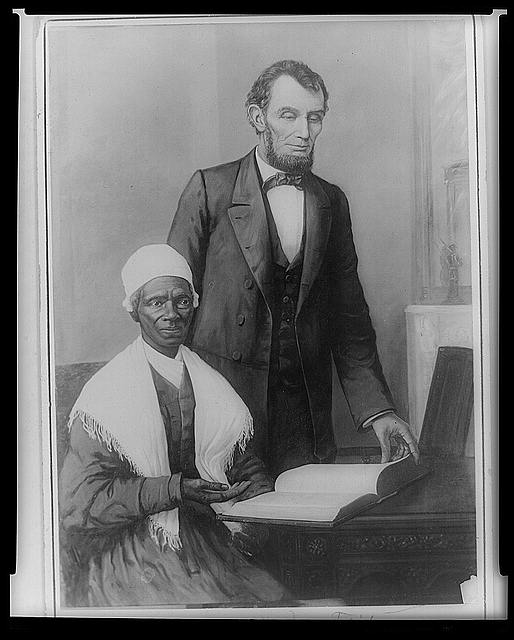
A. Lincoln showing Sojourner Truth the Bible presented by colored people of Baltimore, Executive Mansion, Washington, D.C. ca. 1893. Photograph.

“My name was Isabella; but when I left the house of bondage, I left everything behind. I wa’n’t goin’ to keep nothin’ of Egypt on me, an’ so I went to the Lord an’ asked Him to give me a new name. And the Lord gave me Sojourner, because I was to travel up an’ down the land, showing the people their sins, an’ bein’ a sign unto them. Afterwards I told the Lord I wanted another name, ‘cause everybody else had two names; and the Lord gave me Truth, because I was to declare the truth to the people.” (Harriet Beecher Stowe, “Sojourner Truth, the Libyan Sibyl,” Atlantic Monthly Apr. 1863, 478)

Sojourner Truth, also known as Isabella Baumfree, died on November 26, 2022. Her death had me thinking about the first time I heard her famous speech, “Aint I A Woman.” The interesting thing about history and conversations surrounding memory–is the grey area within the interpretation. For me, nothing can be interpreted fully without taking into account an individual’s sense of self and the psychological perspectives of the community at that time.

Historians have compared and proven the validity of different versions of Truth’s famous speech. Although there was no speech transcript during the convention, her remarks were recounted by abolitionists of the time. Truthfully, how they accurately created two full and different speeches from memory is impressive to me. Perhaps they took notes? Admittedly, something feels incomplete surrounding the information, and I will have to continue my research of the convention. 

However, my initial interpretation of the speech was that she spoke on behalf of her race and on aspects of her womanhood. The reality is that Baumfree was an African woman born into slavery and treated as if she was not a woman in the same way her White counterparts. I often wondered if her laments made subtle jabs at the system and the women around her. 

If the injustices of the past mirror the civil unrest and racial sentiments of today, it is understandable that Truth would convey her true feelings at the convention to some degree. In fact, this was a woman bold enough to run away from her enslavement.

Truth coming to the podium and stating Ain’t I Woman, would be a logical question placed towards people that had to be convinced of her humanity and womanhood. Moreover, it would all make logical sense considering the period of The Cult of True Womanhood (1820-1860) which raised White womanhood to virtue and purity, while subjugating Black womanhood to licentious stereotypes.

What if Truth’s baiting with the phrase Ain’t I A Woman, was her way of waking people up to her plight and the Truth of their own.

Woman’s Rights Convention, Akron, Ohio, May 28 and 29, 1851 

According to the official transcript of the Ohio Women’s Convention at Akron, that took place in 1851 it was recorded that Sojourner Truth commented on education. The purpose of this convention and several others like it, came on the heels of the 1848 Seneca Falls Convention, which fought for women’s social, religious and civil rights. Elizabeth Cady Stanton opened the convention with these words:

“We are assembled to protest against a form of government, existing without the consent of the governed—to declare our right to be free as man is free, to be represented in the government which we are taxed to support, to have such disgraceful laws as give man the power to chastise and imprison his wife, to take the wages which she earns, the property which she inherits, and, in case of separation, the children of her love.” –Elizabeth Cady Stanton, Seneca Falls Convention 1848


Stanton, Elizabeth Cady. Elizabeth Cady Stanton Papers: Miscellany, -1946; Biographical data. – 1946, 1840. Manuscript/Mixed Material.


The need to fight for women’s rights were agreed upon by all women. The only question was who would obtain the rights first. Looking at history and reading the thoughts of the women in attendance at the time, you understand the importance of accepting all people today. If not, you subject them to inhumanity.

You can read the transcript from the convention on the Library of Congress website here. It’ s very interesting and delivers a litany of obvious reasons and examples of a woman’s right to equality, her wages, and her inherited property. 

From The Sojourner Truth Project, you can compare the two speeches for yourself. Given the times, what do you think Sojourner meant? Which speech feels true to you?

Marius Robinson’s transcription:
Published June 21, 1851 in the
The Anti-Slavery Bugle

The oldest account of Truth’s speech that provides more than a passing mention of it was published by Marius Robinson on June 21, 1851 in the Salem Anti‐Slavery Bugle, a few weeks after the speech was given. This version was not the first published account of the Akron speech, but rather the first attempt to convey what Sojourner Truth said in full.

  1. May I say a few words? I want to say a few words about this matter.
  2. I am a woman’s rights.
  3. (a) I have as much muscle as any man, and can do as much work as any man.
  4. (b) I have plowed and reaped and husked and chopped and mowed, and can any man do more than that?
  5. I have heard much about the sexes being equal; I can carry as much as any man, and can (c) eat as much too, if (d) I can get it.
  6. I am as strong as any man that is now.
  7. As for intellect, all I can say is, (e) if women have a pint and man a quart – why can’t she have her little pint full?
  8. You need not be afraid to give us our rights for fear we will take too much, for we cant take more than our pint’ll hold.
  9. The poor men seem to be all in confusion, and dont know what to do.
  10. Why children, if you have woman’s rights, give it to her and you will feel better.
  11. You will have your own rights, and they wont be so much trouble.
  12. I cant read, but I can hear.
  13. I have heard the bible and have learned that Eve caused man to sin.
  14. Well if woman upset the world, do give her a chance to set it right side up again.
  15. The Lady has spoken about Jesus, how he never spurned woman from him, and she was right.
  16. When Lazarus died, Mary and Martha came to him with faith and love and besought him to raise their brother.
  17. And Jesus wept – and Lazarus came forth.
  18. And how came Jesus into the world?
  19. (f) Through God who created him and woman who bore him.
  20. (g)Man, where is your part?
  21. But the women are coming up blessed be God and a few of the men are coming up with them.
  22. But man is in a tight place, the poor slave is on him, woman is coming on him, and he is surely between-a hawk and a buzzard.

Frances Gage’s inacurate version:
23 April 1863 issue of the
New York Independent

The most common yet inaccurate rendering of Truth’s speech—the one that introduced the famous phrase “Ar’n’t I a woman?”—was constructed by Frances Dana Gage, nearly twelve years after the speech was given by Sojourner at the Akron conference. Gage’s version first appeared in the New York Independent on April 23, 1863. 

  1. Well, chillen, whar dar’s so much racket dar must be som’ting out o’kilter.
  2. I tink dat, ’twixt de niggers of de South and de women at de Norf, all a-talking ’bout rights, de white men will be in a fix pretty soon.
  3. But what’s all this here talking ’bout?
  4. Dat man ober dar say dat women needs to be helped into carriages, and lifted over ditches, and to have de best place eberywhar.
  5. Nobody eber helps me into carriages or ober mud-puddles, or gives me any best place.
  6. -And ar’n’t I a woman?
  7. Look at me.
  8. (a) Look at my arm.
  9. (b) I have plowed and planted and gathered into barns, and no man could head me.
  10. -and ar’n’t I a woman?
  11. I could work as much as (c) eat as much as a man, (when (d) I could get it,) and bear de lash as well
  12. -and ar’n’t I a woman?
  13. I have borne thirteen chillen, and seen ’em mos’ all sold off into slavery, and when I cried out with a mother’s grief, none but Jesus heard
  14. -and ar’n’t I a woman?
  15. Den dey talks ’bout dis ting in de head.
  16. What dis dey call it?
  17. Dat’s it, honey.
  18. What’s dat got to do with women’s rights or niggers’ rights?
  19. (e) If my cup won’t hold but a pint and yourn holds a quart, wouldn’t ye be mean not to let me have a little half-measure full?
  20. Den dat little man in black dar, he say women can’t have as much rights as man ’cause Christ wa’n’t a woman.
  21. Whar did your Christ come from?
  22. Whar did your Christ come from?
  23. (f) From God and a woman.
  24. (g)Man had nothing to do with him.
  25. If de fust woman God ever made was strong enough to turn de world upside down all her one lone, all dese togeder ought to be able to turn it back and git it right side up again, and now dey is asking to, de men better let ’em.
  26. Bleeged to ye for hearin’ on me, and now ole Sojourner ha’n’t got nothin’ more to say.

Posted on Leave a comment

“What Is Ours?” A Group Exhibition presented by The Women’s Caucus for Art Washington, DC.

As many of you know this art journey has been my soul’s journey and serves as a well spring of healing. Especially when it is created among a sisterhood. Please join us for an evening of poetry and connection this September 8, 2022. The exhibition will be at the Sandy Spring Museum. There will be an open mic night and we encourage you to come through and speak your mind. Register: The Sandy Spring Museum. See you there!

Posted on Leave a comment

Civic Arts Presents An Inspirational Interview With Artist & Life Coach “MUSE”

An interview with Melissa “MUSE” Colon to liberate your mind

Melissa “MUSE” Colon is a certified life coach and artist who is also the creator of the popular Pep Talks Workshop. She is a newly minted mother of a month old daughter and in today’s interview she speaks with us about purpose, tribe, entrepreneurship, and the importance of community for women.

There are so many gems in this conversation–you won’t want to miss it. I definitely consider myself both a follower and friend of this very magical women.

*Before you click away from the page. Please be sure to scan the QR code or visit our link and give us some feedback on your creative life.

As always, I am here for you in the comments.

Peace be with you and enjoy,

Chiara

Posted on Leave a comment

Where Do You Go For Culture & Creativity

Calling all artists, writers, creatives, makers, dancers and patrons of the arts. We want to know where you go for culture and creativity. Please Scan the QR Code and take our survey. To learn more visit: The Arts and Humanities Council of Montgomery County. #dmv

Best, Chiara

Posted on Leave a comment

World Refugee Day: An Interview With Author and Activist Warda Mohamed Abdullahi On Welcoming Refugees, The Importance of Education, And Inspiring Young Girls

Photo Courtesy of Warda Abdullahi

#ICYMI June 20, 2022, marked the 71st anniversary of World Refugee Day, which is the United Nations’ international day of observance for refugees worldwide. According to the United Nations Refugee Agency (UNHCR), the world is witnessing the highest recorded levels of displacement in history. Over 70 million people have been driven from their home countries due to war, conflict, and persecution, and 30 million are under the age of 18. If given a choice, refugees would almost always choose the familiarity of their culture, the security of their family, and the safety of their homeland.

However, when fleeing is a matter of life and death, they must choose life.

This year’s Refugee Week theme surrounds healing and safety with its motto being: Whoever. Wherever. Whenever. Everyone has the right to seek safety.

“People escaping violence or persecution must be able to cross borders safely. They must not face discrimination at borders or be unfairly denied refugee status or asylum due to their race, religion, gender, or country of origin.”

“People escaping violence or persecution must be able to cross borders safely. They must not face discrimination at borders or be unfairly denied refugee status or asylum due to their race, religion, gender, or country of origin.”

UN Secretary-General António Guterres

America essentially is a nation of immigrants and asylum seekers. All of whom, in the spirit of entrepreneurship, faith, family, and the intense desire for a life of democracy and freedom — wound up here. All of which was done with the help of strangers, the kindness of neighbors, and a supportive community. Even those of us whose ancestors were stolen from their native lands and stripped of their free will, all while being subjected to violence, had a strong desire for America’s promise of a better life. That desire is something that not only I benefit from, but culturally we all benefit from as a nation.

My interview with Warda is not a simple refugee story but of a woman finding her voice and place in the world. Both of those things resonate with me, which is why speaking with Warda was so inspirational. She lost her mother early in life and had to live apart from her father and find refuge in the United States while facing discrimination and overcoming the intense feeling of isolation. Something that refugees often experience when they arrive here.

However, no matter what life threw her, she stood boldly determined in the face of rejection and setbacks by keeping her faith, never compromising her identity, and maintaining a positive mindset. For Warda, it was the dreams of her father and the burning desire for education — and the hope of one day becoming a doctor and helping her community that was her mainstay. While this mom of two is still on her journey, the rewards she gained after her many sacrifices in pursuit of her American dream, will bring tears of joy to your eyes.


Warda’s Interview

Before we dive into everything else, would you please introduce yourself and tell us a little about your background?

My name is Warda Abdullahi, and I was born in Saudi Arabia. I have lived in many different places throughout Africa, where I faced many obstacles, such as loss of education, living through a drought, and losing my mother. But after everything, I still succeeded. I live in Minnesota now. I graduated from Saint Catherine University with a bachelor’s degree in Public Health while I wrote the book, “Warda.”

Why was it so important to you to be the first member of your family to go to college? What did that represent to you?

It represented change, a look into a better life and ditching our former nomadic pastoral lives. The Somalis have this saying which directly translates to “the last camel’s following the first,” so I wanted to be the first to create a chain reaction of success.

What was your first impression of school in America?

On my first day of high school in America, the school was big, and there were so many students, unlike in South Africa. Schools there are smaller, and there are not many students. I was confused. I had never seen students talk back to their teachers. It was certainly a first for me. Back home, we were taught that teachers are our second parents and should always respect them. Treat them as our parents. I could not stop thinking about how this student was not taking advantage of their opportunities around the world; kids their age pray to have an education every day. However, it has alway have been a dream of mine to have access to the best education in the world and despite everything I have been through, it was a fresh start for me where I could pursue my goals and dreams.

Has your relationship with academia been what you thought it would be? We see you have plans to pursue another degree…

Since I was 6, I have always wanted to become a family medicine doctor or a pediatrician. I will continue to pursue that dream, and any additional skills I may acquire will help toward that.

Your mentor, Mackenzie Wellman, wrote a beautiful afterword for your book. How did you two meet, and how did your relationship with her shape your life?

We met through a mentorship program during my junior year of high school at Ottawa Hills High School. Through the years of mentoring me, Mackenzie Wellmen became a family to me. She often comes down to Minnesota and hangs out with my family. She is the kindest and most caring human I have ever met. I am honored to have Mackenzie as my mentor as a first-generation student; she was a godsend as she guided me through applying to scholarships and different universities.

Obviously your story is one of resilience, but it is also one of hardships and self doubt — what kept you moving forward?

My father was my biggest supporter and motivator. He encouraged me to never give up on my education. He always reminds me of how he didn’t get the chance to go college and how all his hopes and dreams had been taken away.

I grew up in a place where every child’s dream was to have an education but was not available or affordable. Because of this, I made it a point to take advantage of the opportunities around me.

You identify as Somali-American, but you’ve lived all over (rural Ethiopia, South Africa, Saudi Arabia, Michigan and now Minnesota ). Do you feel connections to all of these cultures? How so?

Yes, I do feel connected to all these countries I have been to. Even though I was born in Saudi Arabia, I was raised in Ethiopia and this is the country that I am most connected to because I grew up and where most of my family is from. South Africa is the country where my journey to education started and I met my father after 10 years.

Can you discuss some of the unique struggles faced by refugees? You’ve mentioned the importance of highlighting the inequities and injustices that determine who moves freely and where they can live.

Some of the inequities and injustices refugees face are no access to food and water, also education. Throughout my life, refugees have been facing inequalities and no opportunities of education and I believe unless we do something about it, it will not change.

What’s next for you?

My future goal is to go to medical school to become a family medicine doctor and to raise my kids.


Looking Forward

Even when you feel that you are all alone, you are never truly alone. There are always guides, strangers, teachers, friends, and those you have yet to meet, waiting to help you along your path. If we can give aslyum seekers one thing, let’s give them hope.

Every 20 minutes As for aslyum seekers around the world, the journey to America’s gates remain a lighted path to hope and opportunity. To learn more about how you can help welcome refugees visit Welcome.US or the United Nations Refugee Agency to learn more.

For more information on Warda and to read her book visit: https://wardaabdullahi.com

Posted on Leave a comment

The Arts and Humanities Council of Montgomery County Wants To Hear From You

www.tiktok.com/t/ZTd3XxqaD/


AHCMC Take Our Survey

Posted on Leave a comment

ICYMI A Few Ways Companies Can Serve The Community And Their Workers While Implementing A Few Practices

Photo Courtesy of the author


This Earth Month was a great one for me. I finally was able to extend my network and work with people in my community to help implement tools and create processes for change. Typically, I focus on education. But this year, I plan to empower others in their decision-making. This year’s Earth Day theme was “Invest in Our Planet” which called for businesses to implement more sustainable practices. While things like switching to LED light bulbs, adding recyclable paper products to the workspace, and offering remote work are excellent starting points, here are some additional ways companies can still thrive while investing in our planet.

Photo by Wonderlane 


Go Paperless


This is a personal mission of mine. Anytime I see piles of paper and large file cabinets anywhere — I itch. Looking at rows of paper is not only unpleasant, but it gives me IRS vibes, and it’s also lifeless. I mean, it’s a bunch of dead trees. You can’t hug them. They give no life. If you don’t believe me, hug your parking ticket. On a serious note, my biggest goal is to go paperless. To assist me in my quest, I’ve begun to rely heavily on digital note-taking apps like Notability and Goodnotes to organize my thoughts and share information. Coupled with a cloud storage system or an external hard drive, it’s much better than paper. Although we do incur a level of e-waste when you use electronics, I’m still for going paperless when you consider space and the labor involved with managing paper.


Make Hybrid Work More Than An Option


More than 35 North American companies and about 20 global companies are testing out a four-day workweek in a pilot program spearheaded by 4 Day Week Global. 4 Day Week Global is a not-for-profit community established by New Zealanders Andrew Barnes and Charlotte Lockhart to create a better quality of life by urging companies to allow for a shortened week. In doing so, companies can offer their employees a greater work-life balance and address some of the causes leading to the Great Resignation. To me, this is a no-brainer. Fewer employees on-site means there is less need for large office spaces, which means lower costs overall. We live in a digitally advanced society, and the pandemic proved that we can work from our computers.


Some people want to come into their office to work, which should be an option. Owl Labs conducted a study of remote work in September of 2021. They surveyed over 2,000 workers and reported 84% of them reported they would be happier working remotely. The internet allows for extended reach — why be limited to a traditional desk if you don’t have to. Employees burn a lot of time grabbing coffee, chatting by the water cooler, and surfing the internet. It’s doubtful these things will change but will shift while employees work at home. But, companies won’t have to pay the lease on buildings, and commuters don’t have to clog up the roads and pollute the air. It makes fiscal sense to keep overhead low and make remote work and hybrid work permanent options, leaving employees to stay focused on work and manage life’s responsibilities without burnout.


Plant Some Trees In An Underserved Community

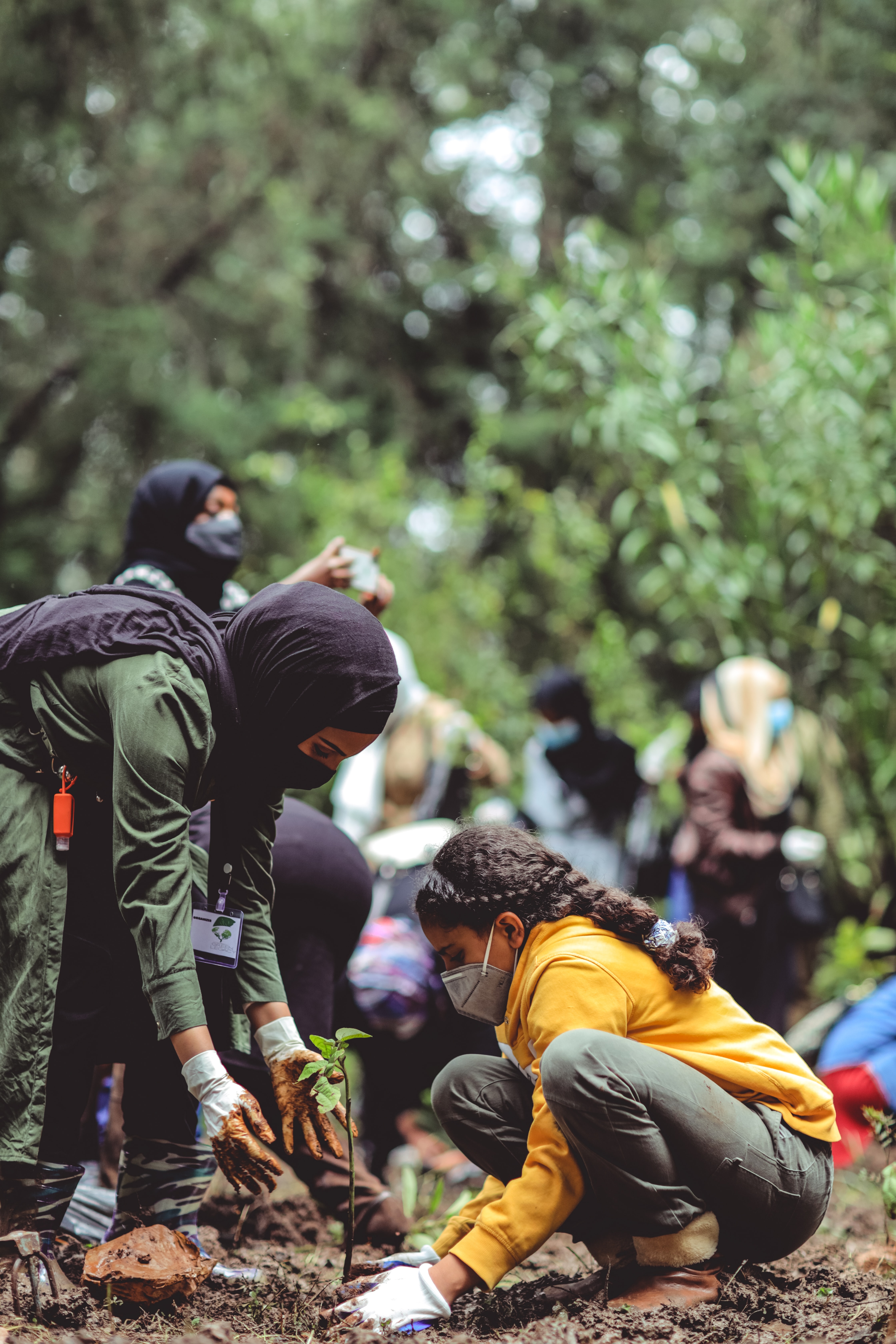
Photo by Eyoel Kahssay 


Companies can really make a difference by funding tree planting. There seems to be a bit of bureaucracy and over complication when it comes to planting trees, but it doesn’t have to be. Yesterday, I bought a grape tree from Ace Hardware and planted it in my yard. It took all of twenty minutes. In a month or so, hopefully I can pick the grapes and make some jam. As you see, no big deal.

Trees produce negative emissions and help mitigate climate risk. Yes, there is a cost associated and decisions to be made regarding the quality of the trees and the how many to plant. But, if you consider the fact that many low-income neighborhoods lack trees, adequate green spaces, or heavily forested areas that provide residents greater opportunities to interact with the natural world, planting a few trees seems like the right thing to do. At 5 dollars a tree plus site preparation this is a good way for companies to walk their talk. The next major step after planting the trees is caring for them. Companies should focus energy there — thinking for the long haul — and watch their green investments grow.


Here are a few organizations already dedicated to this effort:


Onetreeplanted: https://onetreeplanted.org,
Tree Foundation: https://treefoundation.org,
River Smart Homes Shade Trees (DC)https://doee.dc.gov/service/riversmart-homes-shade-tree-planting

Posted on Leave a comment

Is Your Writing Productivity Lagging? Organize Your Thoughts Fast With These Simple Tricks

Writing Tips To Improve Your Productivity

Anyone that has written anything for someone else has found themselves circling the intersections of the dreaded deadline meets the complex subject on numerous occasions. I know I have. I like to go deep into topics and have long conversations with my subjects. These introspective pow wow sessions are good for my soul, making new acquaintances, but not necessarily good for managing time. Especially if reporting and researching are big parts of your writing model. I have discovered what works for me when inspiration is not knocking at my door, and I also use it with my kids. 

Photo Courtesy of Wiki Commons

For example, I was trying to help my son, who has challenges with his executive functioning, write an essay for class. He’s an 11-year-old boy, and he’s fidgety. Truthfully, he’d rather watch Sonic the Hedgehog or play video games than write a narrative essay. He is a phenomenal storyteller, but inspiration never really hits him at the keyboard, and that’s ok. I know he will get there. We all do. I’ve found that relaying clear steps and asking him to write descriptive sentences within a time limit work best. 

The key here is to set a time limit and stick to it. 

If you fail at first, that’s fine. You can add and subtract time here and there. However, for the most part, time needs to work with you. Not against you.

If you agree or have your own tips, drop them in the comments and let me know.   

Posted on 1 Comment

I Can Attest To The Fact That Brain Tumors Suck, Which Is Why I Go Hard For The Environment


More children die from brain tumors than any other cancer; those who survive must navigate a lifetime of side effects. The Pediatric Brain Tumor Foundation (www.curethekids.org/stay-connected) is the largest patient advocacy funder of pediatric brain tumor research and leading champion for families and survivors, providing patients, caregivers, and siblings with information, financial assistance, and a community of support from the moment symptoms start, through diagnosis, treatment, and beyond.

If you logged onto this site a few years back, you will notice that it has gone through several iterations. Initially this website began as a way to bring awareness to pediatric brain tumors and to share how I used art as therapy for my grief journey. I still do. In 2015, my 3-year old daughter named Calais, was diagnosed with a rare tumor called ATRT. At the time she was a perfectly healthy and an extremely active child–cancer was something we never saw coming.

How we got off our path 

When I took my highly active 3-year-old to a pediatrician’s visit, they wanted her weight to be slightly higher, and to have more protein because she was only drinking soy milk. I was told to add a protein drink like Pediasure if she isn’t drinking milk to make sure she was getting her protein and nutrients. Big mistake, it’s all sugar, and it’s the beast that fueled my fire for years after.  

My upbringing did not prepare me to deal with medicine as a parent. My husband often looked to me, and I didn’t always trust my gut–until it was too late. I can’t say sugar causes cancer, but cancer cells feed off sugar. According to Cancer.gov, roughly 1.9 million people will be diagnosed with Cancer in the United States. Education is something we all can benefit from. When you have a belief in something you need a community to keep you on the straight and narrow and to see you through. It’s important to educate yourself on your bloodline as well as your nutrition. One size doesn’t fit all in this area.

Although Calais was technically my second child and 17 months younger than her older brother, I often felt like I was still new and inexperienced as a mom. Especially living in Washington, DC, with a California mindset. As progressive as the city was supposed to be, I often felt talked down to as a Black mother. I shouldn’t have to defend myself or my parenting or be interrogated about things that have nothing to do with the situation. These factors made it hard to parent in general, coupled with the crippling and irrational sense of guilt I felt at being limited in my capacity to help my kids. Surprisingly enough, I lost all of those insecurities during our daughter’s cancer fight. I was empowered and present during her life and death situation. The doctors learned to respect me and often sought after my opinion, which must have been coming from the other side. To give you insight to the situation, I was using medical terminology that was correct. All that is gone now, however, in hindsight I realize I was helping my children more than I understood. My daughter said I was a good mother as her final words.

1.9 million people will be diagnosed with Cancer in the United States. Education is something we all can benefit from.

Going through approximately a decade of challenges made me question alot of things. I always thought to myself, God wouldn’t double down on us, would he? Yes, He would, and it showed me that people deal with even more while having little to no resources. 

My biggest regret has been having a level of knowledge that was ahead of its time and not always using it for myself. I was good for imparting it to others and not always able to apply it to myself when challenged by institutionalized mindsets. When you grow up around family members trained in the traditional medical system, you may receive a lot of pushback on ideas, treatments, and remedies that have no “scientific basis.” Today, many unproven folk practices are being recognized and investigated as treatments needed to cure illnesses. This is excellent news. Still, they all need funding in order to bring them to the masses and to allow for proper testing. 

 Get In Community

For me, a helpful group was Mocha Moms Inc. As a mother of color, you won’t find a better group of nationally organized, locally informed, and compassionate women who value family and children more.

During my daughter’s battle with ATRT, I went into overdrive making remedies and sending research papers to the oncologists to help her. Miracles were happening, and it was amazing. Our cancer journey took us from Washington, DC, to Philadelphia, and finally to San Francisco on a quest to discover a life-saving treatment. It was a constant emotional roller-coaster filled with countless heartbreaks and many triumphs. Eventually, she did leave us, but not without showing us a better way to live.

Brighter Days Ahead

When a parent loses a child, it can be hard to recover. I am grateful to God that I did, even though it took a minute. Thankfully, we have been given a second chance with our daughter Monarch. She is the only child I carried full term. I did pregnancy my way and remained primarily stress free. She is my veggie, yoga baby, whom I spent lots of time forest bathing and grounding with while pregnant. I even had her at advanced maternal age–so never stop believing.  

Before my daughter’s death, I lived a high-stress life full of people pleasing. That is not the case today. We raise our children differently than we used to. Even as Black children, I want them to be free-thinking, have a close relationship with the environment, and radiate with love. Never underestimate the effects of stress on you, and how it transfers to your children. These things matter. They used to call me a hippie and a flower child. Now, Black hippies are everywhere, and I am committed to a life of sustainability to the best of my ability while educating others as well. Just maybe, you can will be inspired to become more concsious and live a better life, starting today.

Posted on Leave a comment

5 Things To Consider Before Getting Your Residential Solar Panels, It’s Simpler Than You Think

black solar panels on brown roof
Photo by Vivint Solar on Pexels.com

By now, many of us have read, or heard about, the Intergovernmental Panel on Climate Change’s (IPCC) damning report on the state of the environment. On April 4, 2022- UN Secretary-General António Guterres’ made a public appeal to environmental leaders and the global community at-large, to hold leaders accountable for our climate issue. In his brief video, Guterres called for the swift implementation of renewable energy, in order to mitigate the rapidly accruing damages of greenhouse gas emissions, that stem from energy production.

The report came out a week after we installed our own residential solar panels. This is a huge win for our family as we push towards a more sustainable lifestyle. Over the past few years, I have come into an awareness that my desired minimalist, handcrafted lifestyle not only had a name, but a whole community — sustainable living — -and it’s very diverse in terms of ideas.

I often find that there are many people that have heard concepts surrounding renewable energy, zero waste living, and living off-grid but it seems out of reach or overly complex. However, it doesn’t have to be. One of the main ideologies of sustainable living involves everyone doing their part and giving space for our world will begin to recover organically.

What is renewable energy?

Renewable energy comes from natural sources like sunlight, wind, rain, plants, waves, and geothermal heat from the Earth’s core.

It’s good for the environment, good for you and cost-effective over time. 


The Biden-Harris administration has set a goal of creating a carbon pollution-free power sector by 2035. While some still feel that this is an ambitious goal, everyday citizens can make the decision to get the balls of change rolling, and solar energy is a great start.

Residential solar energy is a way to reduce skyrocketing big energy costs and can quickly advance your sustainable goals and help improve our environment. Homeguide.com, residential panels can run from $10,000-$27,000 after the tax incentive. For many people, especially from low-income and marginalized communities solar panels will be a challenge for them to obtain. Even for middle class families, the expense can be too high. Thankfully, non-profits like Solstice Initiatives ,and the Black woman-owned WeSolar, are providing equity with community solar energy — no rooftop needed.

Photo by Jed Owen on Unsplash

If you do have a roof and you are excited to get started, here are 5 things to consider:

The Tax Credit. Time is ticking on the residential solar federal tax credit. The federal tax credit expires in 2024, unless Congress renews it. Currently, there is a 26% tax credit for homeowners. That decreases to 22% by 2023. According to Energy.gov, here’s how the costs are calculated:
For example, if your solar PV system was installed before December 31, 2022, cost $18,000, and your utility gave you a one-time rebate of $1,000 for installing the system, your tax credit would be calculated as follows: 
0.26 *($18,000 — $1,000) = $4,420 

If you are a homeowner and those savings matter to you, it’s time to get focused on making it happen.

Choosing the right company. Choose a company that doesn’t overcharge you upfront and essentially take away what you would be getting back in rebates. It’s always good to do your research and price compare. I would recommend no less than 3–6 months in order to do a deep dive into prices on the install, monitoring, and rebates. You can start here or if you are handy, go DIY.

Size matters. Bigger panels equals bigger savings. Which means more cost for you. You can expect to recoup the total cost 15–20 years down the line. But you will see the benefits in savings long before that. Also keep in mind, this is a season of legacy building. What you set up today is what you are leaving your family to improve upon and pass down for generations.

Understand your needs. Are you looking to cut costs on electricity or also have a battery back up? Tesla’s Powerall is an example of the battery backup system that gives you that near total independence you crave, but you will also need to buy their panels. You can’t purchase the Powerall as a standalone item.

Know the laws of your state because they vary. Solar panels may simply be a start for you. Maybe you want to DIY-it and go totally off-grid in the city. I would advise you to take a look at Primal Survivor. They’ve created an interactive map documenting off-grid laws in almost every state. Which is something to consider and also helpful in learning to manage your expectations with your solar setup.

I also hope that my fully transparent, lifelong pursuit of a sustainable life, will help ground some of the big ideas surrounding the environment and you can see where you fit inside the fight. This way of living ensures a good quality of life for all. In doing so, true change will emerge one family at a time.

Be sure to send me a message, or clap this story, if you found it helpful.

Posted on Leave a comment

Why the Solution for Food Justice in the Black Community Means Reacquainting Itself with Its Village

Activists in Washington D.C.’s Ward 7 are raising the bar, and awareness, on the city’s ongoing food insecurity issue.

By Chiara Atoyebi

Family photo courtesy of the author

When I was a small child living in Detroit, my mother would drop me off at my grandmother’s house before heading out to her night shift at Henry Ford Hospital. At the time, my grandmother still worked with her hands. She was skilled at decorating, growing vegetables, and cooking up savory meals overflowing with flavor and aromatic spices.

Grandma would have a nightly ritual of frying fish, served on a slice of white bread with a dash of Louisiana hot sauce to all the family. Stevie Wonder or Luther Vandross would blare from the radio speakers as she passed out the silverware. She would smile, content with the look on our happy faces, as she backed her way into the kitchen through wooden beads humming to herself. 

I remember gathering around the kitchen table with my aunts and cousins, smiling and eating. My grandmother would give the table a once over before sending someone next door to “borrow” some sugar. 

“Tell Peaches’ momma I’ll pay her back.”

She never did, but it was never a problem with the neighbors. There was always sugar and whatever else was needed. When somebody’s food went low, someone in the neighborhood always stepped in. We were all family. The community was our village. It made me feel safe and secure when I was away from my mother. 

Yet when the food really ran out, it was gone. All the way gone. During that time the smiles, and the laughter, left with it. Only to be replaced with frustration and agitation. 

External factors such as emotional stress, low living wages, poor living conditions, and a lack of access to quality and nutritious food present a persistent barrier to wellness. 

According to a 2008 NIH study, emotional stress is a significant factor that contributes to the six leading illnesses that can cause death. Heart disease, cancer, lung ailments, accidents, cirrhosis of the liver, and suicide make up most medical complaints. 

Yet when the food really ran out, it was gone. All the way gone. During that time the smiles, and the laughter, left with it. Only to be replaced with frustration and agitation. 

These issues often go unmitigated, leaving African Americans more than any other group, in various stages of declining health. As a country, we are reckoning with long-standing systemic practices rooted in our foundation that are inherently racist. One of the greatest disparities we face in our nation is within our food system.  

Food apartheid, Food Swamps, and Food Deserts are implications of those practices

In February of 2021, D.C. Mayor Muriel Bowser released a food policy report charting the number of food insecure populations in the District of Columbia before and after the pandemic’s height. Food insecurity is up by 16% from 10.6% pre-COVID. The report outlined funds that will aid in the stabilization of food workers, and support food security, in the coming year.

Hopefully, this much-needed initiative will find a way into the District’s ward 8, which currently has one grocery store per 85,160 residents, vs. DC’s Ward 3, which boasts an egregious 1 grocery store for every 9, 336 residents. Ward 3 is home to the wealthiest and the whitest residents of the district, while Ward 7 is comprised mainly of Black and Brown families.

Mary Blackford is the founder of Market7, a premier marketplace of Black-Owned businesses, and a longtime Ward 7 resident. While visiting Ghana, Blackford witnessed autonomy within its communities and marketplaces. During her visit, she became deeply inspired by those spaces and set out to recreate what she saw upon returning stateside. 

“We have a serious food apartheid issue,” says Blackford in an interview with Washingtonian Magazine. 

“Food desert kind of sounds like it’s a natural occurrence. Food apartheid speaks to this really intentional act of discriminatory practices and even laws against communities of color, specifically Black communities.”

Regaining autonomy through community-based practices is deeply rooted in African American and African Diasporic traditions. Not only is the installation of Black-owned businesses in the community an integral part of restoring the village, but a return to the soil is as well. 

The District’s nonprofit “Dreaming Out Loud” is the organization behind The Farm at Kelly Miller in ward 7. According to their website, “Dreaming Out Loud” aims to use the food system as a powerful tool of resistance, resilience, and advocacy for structural change.  

In their 2021 Food Policy report, DC Food Policy outlined three strategies toward a path for creating a more secure food system. A large part of this initiative is to invest in community markets like Market 7. They promote grants for farmers of color and educate people on the link between nutrition and wellness.

Back in Detroit, my family worked with the land. Even though it was small, and in our backyard, it was ours. The women of my family were peaceful as they pulled tomatoes off the vine in the backyard. They cut cucumbers and snapped peas too. Whatever was leftover they would often share. Admittedly, I took those small aspects of community for granted, thinking they would always be there. Yet over time, they faded away.  

The All-Nite Images from NY, NY, USA, CC BY-SA 2.0 https://creativecommons.org/licenses/by-sa/2.0, via Wikimedia Commons

I’m still hopeful, and I always have been. I still believe in the village mentality and extended family communing together through food. When we were like this, we had fewer hungry people. In the mid-eighties, I’d already left my family behind in Detroit. My mother joined the military, and we were off to Kansas, then Berlin, and–we never looked back. By that time, I was watching the rise of hip-hop from overseas and the fall of the Berlin Wall on our home front. 

Never would I forget the times around the table with my family. The laughter as well as the heartache. Nor did I forget the losses that occurred when we stopped working with our hands, when we lost the men of our village, and the dignity in our food choices. 

Thankfully today’s activists are focused–they will not be moved in the pursuit of equality. Through raised awareness and community effort, the residents of Ward 7 are putting down roots and establishing traditions. A much-needed guiding light on the road to food justice.

For a comprehensive look at food insecurity in the Washington, D.C. are visit: www.anacostia.si.edu and their “Food for the People: Eating and Activism in Greater Washington”–to learn more.

Posted on Leave a comment

It’s Officially April, Time To Revisit Those New Year’s Resolutions. How Are Yours Stacking Up?

Clip Art by Vector Toons, CC BY-SA 4.0 https://creativecommons.org/licenses/by-sa/4.0, via Wikimedia Commons

Today is Wednesday, and as a mom who also works from home with her kids and a toddler learning to potty train—the days often roll into the night. The busyness of life alone is enough to swallow a person up whole. But, I’ve mastered a technique to share so that it doesn’t. Can you relate? This month, I felt it was essential to check in with myself and revisit the informal resolutions I made at the start of the year to see how I’m measuring up. If I’m being honest, I am doing well. Especially after identifying my vices and replacing them with my virtues in order to stay committed to my resolutions. Here is how you can too, even if you have a lot going on. 

We’re all familiar with the annual ritual of starting the new year with a fresh set of resolutions. For as long as I can remember, exercise has always been my number one. In January, it’s like a grand opening on the workout front. Swarms of people cramming the elliptical machines, boxing each other out in the weight room, and for positions in the mirror. After about 90 days, folks typically see some results, stop going, the excitement wears down, and we forget the work we put in to get us where we want to be. This year was different. I wanted to create better habits, manage my self-care, and see if an overall improved quality of life would make a difference. I believe it has.

As long as we are intentional with our self-discovery and endeavor to understand our unique pitfalls, we can set our minds in a high place and easily crush every goal we set. 

Making resolutions, and vowing to see them through, is a great way to reset and is an opportunity to do so with like-minded people. However, according to a poll conducted by CBS News only 29% of Americans made resolutions going into 2022. This statistic isn’t too much of a shock. Life is unpredictable, and it seems the best way to work it is one day at a time.

The pandemic showed us that what we need is more personal happiness, a greater sense of community, a better work-life balance, and work that is meaningful. When we can aptly identify what those things are for us, like negotiating a higher salary, losing twenty pounds, and spending more time with family. In doing so we develop patience and become more attuned to what comes naturally. (See the great resignation).

In order to see progress, it’s time to get focused on what makes you happy and ground yourself in that mission—and the opportunities will follow. Let’s examine a few strategies for success so that you don’t fall off the wagon for the remainder of the year. For me, this is achieved by knowing my vices and replacing them with some virtues

But first, what exactly is a resolution? I like to be pragmatic with my intentions so it’s best to know exactly what the word means. The Merriam-Webster dictionary defines resolution as an act of determining. You must ask yourself what have you resolved to do and what are some deterrents? Below are some common ways we keep ourselves from achieving our goals. 

What is your why? 

A visualization coach may advise you to figure out your WHY? 

When I hear that, I quickly jot down things like, “I want to be healthy. I want to run around with my kids. I want to look like a whole snack when I show up at my husband’s office.” I’m also here to tell you that if you repeatedly falter, perhaps your isn’t as strong as you think, and you may need to keep digging. World heavyweight champion Mike Tyson says that “Discipline is doing what you hate to do, but nonetheless doing it like you love it.” Who better to speak to discipline that a prize fighter.

Finding your “why” is a tricky thing, and that is where discipline kicks in. Discipline goes hand in hand with commitment. If you can lay hold to these two things, you will begin to slowly separate yourself from the pack. 

“Discipline is doing what you hate to do, but

nonetheless doing it like you love it.”

— Mike Tyson

By examining your own psychology, you can end some of your self-sabotaging ways. You must be an expert in you.com. By understanding how our seemingly harmless vices can disrupt our commitments, we can slowly incorporate more virtuous behaviors and bring your life into balance.

Here is a list of virtues and vices:

If your April isn’t going quite as planned; no worries, it’s never too late to hop

back into the saddle. Now that you understand the vices vs. virtues model for commitment, I hope you feel encouraged in your discipline. I would love to hear what you have going on in the comments. 

Posted on Leave a comment

The March of Dimes Just Released An Enhanced Training To Address Disparities in Healthcare, Just In Time For Black Maternal Health Week

Photo by Toro Tseleng on Unsplash

Things are looking up for mothers and babies in the fight to reduce chronic discrimination in healthcare, specifically in Obstetrics and Gynecology. Today the March of Dimes released its enhanced implicit bias training to address disparities in healthcare. The newly configured “Awareness to Action: Dismantling Bias in Maternal and Infant Healthcare™” available virtually as a 1.5-hour e-learning module or as a 3-4 hour in-person class. This module is released just in time for Black Maternal Health Week, which is recognized every year from April 11-17. 

According to the March of Dimes, “the U.S. remains among the most dangerous developed nations for women to give birth.” The latest 2021 March of Dimes Report Card shows Black, American Indian, and Alaska Native women and their babies, consistently have worse health outcomes than their white peers. Additionally, there are a few intersecting factors that contribute to these outcomes, such aas a variation in quality healthcare, structural racism, and implicit bias, to name a few. The good news is that these issues are being mitigated by raising more awareness and implementing equitable systems. The key to making substantive long lasting changes are rooted in policy, institutions, and by working in tandem with the communities they serve. 

Photo by TUBARONES PHOTOGRAPHY on Pexels.com

What exactly is implicit bias? The Merriam-Webster dictionary defines implicit bias as a bias or prejudice that is present but not consciously held or recognized. We all have them, and they are typically created by our culture, rooted in our upbringing, and informed by the larger society. The danger is when healthcare professionals, knowingly or unknowingly,are affected by them and treat patients from a place of prejudice. Studies show that the outcomes of implicit bias can prove deadly. Ironically, these biases traverse across all races, gender, and socioeconomic status, while administering the harshest blow to women of color, which signifies a necessary and much-needed change at the structural level. 

The “Awareness to Action: Dismantling Bias in Maternal and Infant Healthcare™ aims to define implicit bias, describe structural racism, apply strategies, and commit to a culture of equity. 

I am among many African American women who have felt unheard, dismissed, and not taken seriously when relaying concerns to my physician during my pregnancy, and I had outstanding health insurance. Yet, I believe that not being heard attributed to my symptoms of depression during my first pregnancy and extended my postpartum symptoms long after. 

Thankfully, advocates like Black Mamas Matter Alliance are working hard to deepen the conservation around Black maternal health and work towards parity in treatment for women of color. Pregnancy is a time of excitement, and Black women can be made to feel as if motherhood is a burden. Disparities in healthcare stops now, and it will take all of us becoming more informed and knowing how to take action. 

For information on how you can get involved, get help, or raise awareness, you can visit:

“Awareness to Action: Dismantling Bias in Maternal and Infant Healthcare™” visit: marchofdimes.org/implicitbiastraining. 

CDC Black Maternal Health Week information: https://www.cdc.gov/healthequity/features/maternal-mortality/index.html

Doulas of Capitol Hill https://www.doulasofcapitolhill.com/blog1/2020/08/28/resource-guide-for-black-moms-in-the-dmv