Where faith and creativity meet to tell life’s most meaningful stories.
At Chiara Atoyebi Media, I believe art is ministry—every story, image, and design is a way to share light and love.
I’m Chiara, an artist, writer, and educator devoted to building spaces where family, faith, and folklore come alive. From digital storytelling to handmade art and The House of Maryam Creative Center for Peace and Transformation, my work celebrates the sacred in everyday life.
And at the heart of it all? My greatest inspiration—my 15-year-old son, a writer and gamer known as @Sonicgamedex. Join Our New family endeavor #yourcrossisyourcrown
This Earth Month was a great one for me. I finally was able to extend my network and work with people in my community to help implement tools and create processes for change. Typically, I focus on education. But this year, I plan to empower others in their decision-making. This year’s Earth Day theme was “Invest in Our Planet” which called for businesses to implement more sustainable practices. While things like switching to LED light bulbs, adding recyclable paper products to the workspace, and offering remote work are excellent starting points, here are some additional ways companies can still thrive while investing in our planet.
This is a personal mission of mine. Anytime I see piles of paper and large file cabinets anywhere — I itch. Looking at rows of paper is not only unpleasant, but it gives me IRS vibes, and it’s also lifeless. I mean, it’s a bunch of dead trees. You can’t hug them. They give no life. If you don’t believe me, hug your parking ticket. On a serious note, my biggest goal is to go paperless. To assist me in my quest, I’ve begun to rely heavily on digital note-taking apps like Notability and Goodnotes to organize my thoughts and share information. Coupled with a cloud storage system or an external hard drive, it’s much better than paper. Although we do incur a level of e-waste when you use electronics, I’m still for going paperless when you consider space and the labor involved with managing paper.
Make Hybrid Work More Than An Option
More than 35 North American companies and about 20 global companies are testing out a four-day workweek in a pilot program spearheaded by 4 Day Week Global. 4 Day Week Global is a not-for-profit community established by New Zealanders Andrew Barnes and Charlotte Lockhart to create a better quality of life by urging companies to allow for a shortened week. In doing so, companies can offer their employees a greater work-life balance and address some of the causes leading to the Great Resignation. To me, this is a no-brainer. Fewer employees on-site means there is less need for large office spaces, which means lower costs overall. We live in a digitally advanced society, and the pandemic proved that we can work from our computers.
Some people want to come into their office to work, which should be an option. Owl Labs conducted a study of remote work in September of 2021. They surveyed over 2,000 workers and reported 84% of them reported they would be happier working remotely. The internet allows for extended reach — why be limited to a traditional desk if you don’t have to. Employees burn a lot of time grabbing coffee, chatting by the water cooler, and surfing the internet. It’s doubtful these things will change but will shift while employees work at home. But, companies won’t have to pay the lease on buildings, and commuters don’t have to clog up the roads and pollute the air. It makes fiscal sense to keep overhead low and make remote work and hybrid work permanent options, leaving employees to stay focused on work and manage life’s responsibilities without burnout.
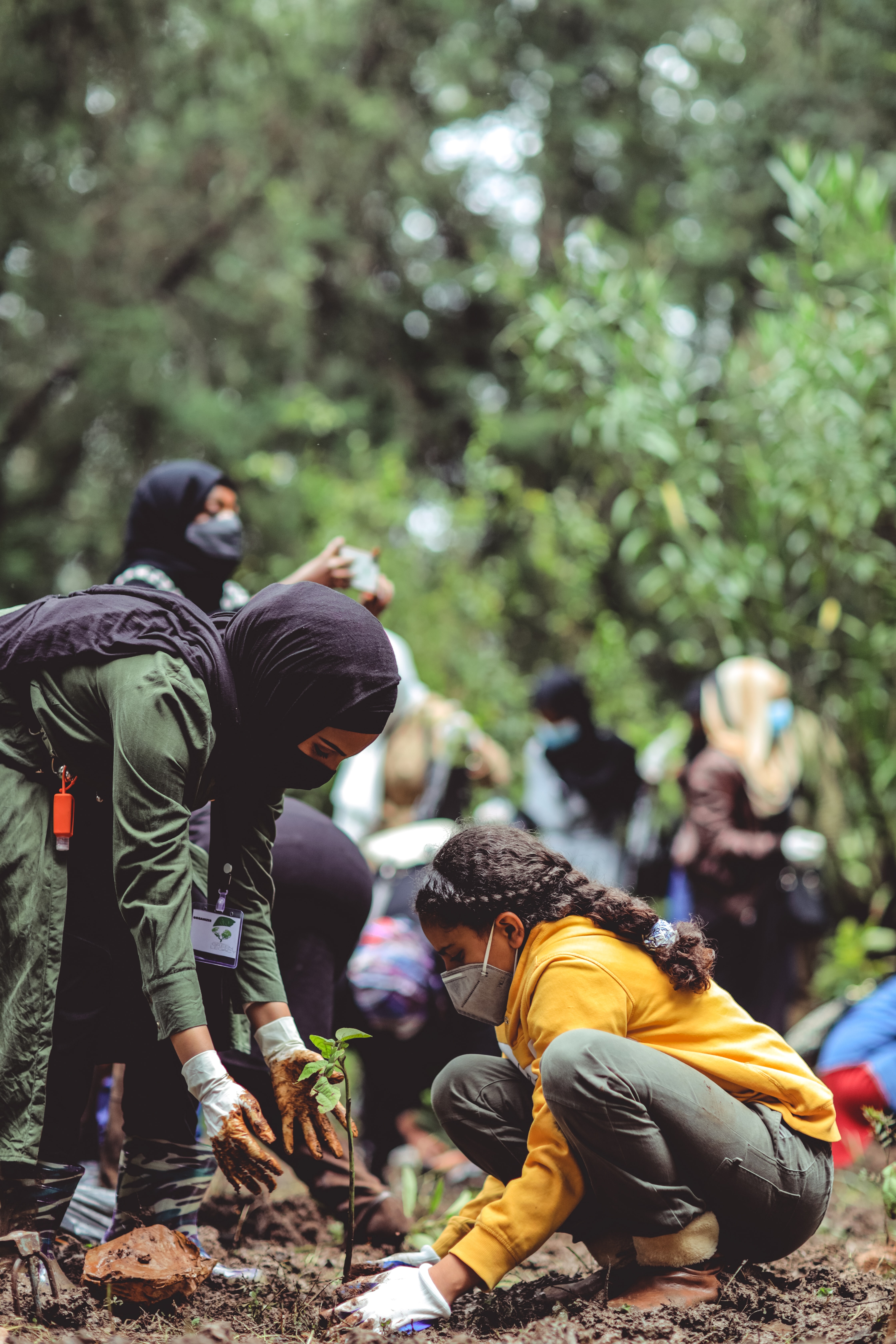
Companies can really make a difference by funding tree planting. There seems to be a bit of bureaucracy and over complication when it comes to planting trees, but it doesn’t have to be. Yesterday, I bought a grape tree from Ace Hardware and planted it in my yard. It took all of twenty minutes. In a month or so, hopefully I can pick the grapes and make some jam. As you see, no big deal.
Trees produce negative emissions and help mitigate climate risk. Yes, there is a cost associated and decisions to be made regarding the quality of the trees and the how many to plant. But, if you consider the fact that many low-income neighborhoods lack trees, adequate green spaces, or heavily forested areas that provide residents greater opportunities to interact with the natural world, planting a few trees seems like the right thing to do. At 5 dollars a tree plus site preparation this is a good way for companies to walk their talk. The next major step after planting the trees is caring for them. Companies should focus energy there — thinking for the long haul — and watch their green investments grow.
Here are a few organizations already dedicated to this effort:
Anyone that has written anything for someone else has found themselves circling the intersections of the dreaded deadline meets the complex subject on numerous occasions. I know I have. I like to go deep into topics and have long conversations with my subjects. These introspective pow wow sessions are good for my soul, making new acquaintances, but not necessarily good for managing time. Especially if reporting and researching are big parts of your writing model. I have discovered what works for me when inspiration is not knocking at my door, and I also use it with my kids.
Photo Courtesy of Wiki Commons
For example, I was trying to help my son, who has challenges with his executive functioning, write an essay for class. He’s an 11-year-old boy, and he’s fidgety. Truthfully, he’d rather watch Sonic the Hedgehog or play video games than write a narrative essay. He is a phenomenal storyteller, but inspiration never really hits him at the keyboard, and that’s ok. I know he will get there. We all do. I’ve found that relaying clear steps and asking him to write descriptive sentences within a time limit work best.
The key here is to set a time limit and stick to it.
If you fail at first, that’s fine. You can add and subtract time here and there. However, for the most part, time needs to work with you. Not against you.
If you agree or have your own tips, drop them in the comments and let me know.
More children die from brain tumors than any other cancer; those who survive must navigate a lifetime of side effects. The Pediatric Brain Tumor Foundation (www.curethekids.org/stay-connected) is the largest patient advocacy funder of pediatric brain tumor research and leading champion for families and survivors, providing patients, caregivers, and siblings with information, financial assistance, and a community of support from the moment symptoms start, through diagnosis, treatment, and beyond.
If you logged onto this site a few years back, you will notice that it has gone through several iterations. Initially this website began as a way to bring awareness to pediatric brain tumors and to share how I used art as therapy for my grief journey. I still do. In 2015, my 3-year old daughter named Calais, was diagnosed with a rare tumor called ATRT. At the time she was a perfectly healthy and an extremely active child–cancer was something we never saw coming.
How we got off our path
When I took my highly active 3-year-old to a pediatrician’s visit, they wanted her weight to be slightly higher, and to have more protein because she was only drinking soy milk. I was told to add a protein drink like Pediasure if she isn’t drinking milk to make sure she was getting her protein and nutrients. Big mistake, it’s all sugar, and it’s the beast that fueled my fire for years after.
My upbringing did not prepare me to deal with medicine as a parent. My husband often looked to me, and I didn’t always trust my gut–until it was too late. I can’t say sugar causes cancer, but cancer cells feed off sugar. According to Cancer.gov, roughly 1.9 million people will be diagnosed with Cancer in the United States. Education is something we all can benefit from. When you have a belief in something you need a community to keep you on the straight and narrow and to see you through. It’s important to educate yourself on your bloodline as well as your nutrition. One size doesn’t fit all in this area.
Although Calais was technically my second child and 17 months younger than her older brother, I often felt like I was still new and inexperienced as a mom. Especially living in Washington, DC, with a California mindset. As progressive as the city was supposed to be, I often felt talked down to as a Black mother. I shouldn’t have to defend myself or my parenting or be interrogated about things that have nothing to do with the situation. These factors made it hard to parent in general, coupled with the crippling and irrational sense of guilt I felt at being limited in my capacity to help my kids. Surprisingly enough, I lost all of those insecurities during our daughter’s cancer fight. I was empowered and present during her life and death situation. The doctors learned to respect me and often sought after my opinion, which must have been coming from the other side. To give you insight to the situation, I was using medical terminology that was correct. All that is gone now, however, in hindsight I realize I was helping my children more than I understood. My daughter said I was a good mother as her final words.
1.9 million people will be diagnosed with Cancer in the United States. Education is something we all can benefit from.
Going through approximately a decade of challenges made me question alot of things. I always thought to myself, God wouldn’t double down on us, would he? Yes, He would, and it showed me that people deal with even more while having little to no resources.
My biggest regret has been having a level of knowledge that was ahead of its time and not always using it for myself. I was good for imparting it to others and not always able to apply it to myself when challenged by institutionalized mindsets. When you grow up around family members trained in the traditional medical system, you may receive a lot of pushback on ideas, treatments, and remedies that have no “scientific basis.” Today, many unproven folk practices are being recognized and investigated as treatments needed to cure illnesses. This is excellent news. Still, they all need funding in order to bring them to the masses and to allow for proper testing.
Get In Community
For me, a helpful group was Mocha Moms Inc. As a mother of color, you won’t find a better group of nationally organized, locally informed, and compassionate women who value family and children more.
During my daughter’s battle with ATRT, I went into overdrive making remedies and sending research papers to the oncologists to help her. Miracles were happening, and it was amazing. Our cancer journey took us from Washington, DC, to Philadelphia, and finally to San Francisco on a quest to discover a life-saving treatment. It was a constant emotional roller-coaster filled with countless heartbreaks and many triumphs. Eventually, she did leave us, but not without showing us a better way to live.
Brighter Days Ahead
When a parent loses a child, it can be hard to recover. I am grateful to God that I did, even though it took a minute. Thankfully, we have been given a second chance with our daughter Monarch. She is the only child I carried full term. I did pregnancy my way and remained primarily stress free. She is my veggie, yoga baby, whom I spent lots of time forest bathing and grounding with while pregnant. I even had her at advanced maternal age–so never stop believing.
Before my daughter’s death, I lived a high-stress life full of people pleasing. That is not the case today. We raise our children differently than we used to. Even as Black children, I want them to be free-thinking, have a close relationship with the environment, and radiate with love. Never underestimate the effects of stress on you, and how it transfers to your children. These things matter. They used to call me a hippie and a flower child. Now, Black hippies are everywhere, and I am committed to a life of sustainability to the best of my ability while educating others as well. Just maybe, you can will be inspired to become more concsious and live a better life, starting today.
By now, many of us have read, or heard about, the Intergovernmental Panel on Climate Change’s (IPCC) damning report on the state of the environment. On April 4, 2022- UN Secretary-General António Guterres’ made a public appeal to environmental leaders and the global community at-large, to hold leaders accountable for our climate issue. In his brief video, Guterres called for the swift implementation of renewable energy, in order to mitigate the rapidly accruing damages of greenhouse gas emissions, that stem from energy production.
The report came out a week after we installed our own residential solar panels. This is a huge win for our family as we push towards a more sustainable lifestyle. Over the past few years, I have come into an awareness that my desired minimalist, handcrafted lifestyle not only had a name, but a whole community — sustainable living — -and it’s very diverse in terms of ideas.
I often find that there are many people that have heard concepts surrounding renewable energy,zero waste living, and living off-grid but it seems out of reach or overly complex. However, it doesn’t have to be. One of the main ideologies of sustainable living involves everyone doing their part and giving space for our world will begin to recover organically.
What is renewable energy?
Renewable energy comes from natural sources like sunlight, wind, rain, plants, waves, and geothermal heat from the Earth’s core.
It’s good for the environment, good for you and cost-effective over time.
The Biden-Harris administration has set a goal of creating a carbon pollution-free power sector by 2035. While some still feel that this is an ambitious goal, everyday citizens can make the decision to get the balls of change rolling, and solar energy is a great start.
Residential solar energy is a way to reduce skyrocketing big energy costs and can quickly advance your sustainable goals and help improve our environment. Homeguide.com, residential panels can run from $10,000-$27,000 after the tax incentive. For many people, especially from low-income and marginalized communities solar panels will be a challenge for them to obtain. Even for middle class families, the expense can be too high. Thankfully, non-profits like Solstice Initiatives ,and the Black woman-owned WeSolar, are providing equity with community solar energy — no rooftop needed.
If you do have a roof and you are excited to get started, here are 5 things to consider:
The Tax Credit. Time is ticking on the residential solar federal tax credit. The federal tax credit expires in 2024, unless Congress renews it. Currently, there is a 26% tax credit for homeowners. That decreases to 22% by 2023. According to Energy.gov, here’s how the costs are calculated: For example, if your solar PV system was installed before December 31, 2022, cost $18,000, and your utility gave you a one-time rebate of $1,000 for installing the system, your tax credit would be calculated as follows: 0.26 *($18,000 — $1,000) = $4,420
If you are a homeowner and those savings matter to you, it’s time to get focused on making it happen.
Choosing the right company. Choose a company that doesn’t overcharge you upfront and essentially take away what you would be getting back in rebates. It’s always good to do your research and price compare. I would recommend no less than 3–6 months in order to do a deep dive into prices on the install, monitoring, and rebates. You can start here or if you are handy, go DIY.
Size matters. Bigger panels equals bigger savings. Which means more cost for you. You can expect to recoup the total cost 15–20 years down the line. But you will see the benefits in savings long before that. Also keep in mind, this is a season of legacy building. What you set up today is what you are leaving your family to improve upon and pass down for generations.
Understand your needs. Are you looking to cut costs on electricity or also have a battery back up? Tesla’s Powerall is an example of the battery backup system that gives you that near total independence you crave, but you will also need to buy their panels. You can’t purchase the Powerall as a standalone item.
Know the laws of your state because they vary. Solar panels may simply be a start for you. Maybe you want to DIY-it and go totally off-grid in the city. I would advise you to take a look at Primal Survivor. They’ve created an interactive map documenting off-grid laws in almost every state. Which is something to consider and also helpful in learning to manage your expectations with your solar setup.
I also hope that my fully transparent, lifelong pursuit of a sustainable life, will help ground some of the big ideas surrounding the environment and you can see where you fit inside the fight. This way of living ensures a good quality of life for all. In doing so, true change will emerge one family at a time.
Be sure to send me a message, or clap this story, if you found it helpful.
Activists in Washington D.C.’s Ward 7 are raising the bar, and awareness, on the city’s ongoing food insecurity issue.
By Chiara Atoyebi
Family photo courtesy of the author
When I was a small child living in Detroit, my mother would drop me off at my grandmother’s house before heading out to her night shift at Henry Ford Hospital. At the time, my grandmother still worked with her hands. She was skilled at decorating, growing vegetables, and cooking up savory meals overflowing with flavor and aromatic spices.
Grandma would have a nightly ritual of frying fish, served on a slice of white bread with a dash of Louisiana hot sauce to all the family. Stevie Wonder or Luther Vandross would blare from the radio speakers as she passed out the silverware. She would smile, content with the look on our happy faces, as she backed her way into the kitchen through wooden beads humming to herself.
I remember gathering around the kitchen table with my aunts and cousins, smiling and eating. My grandmother would give the table a once over before sending someone next door to “borrow” some sugar.
“Tell Peaches’ momma I’ll pay her back.”
She never did, but it was never a problem with the neighbors. There was always sugar and whatever else was needed. When somebody’s food went low, someone in the neighborhood always stepped in. We were all family. The community was our village. It made me feel safe and secure when I was away from my mother.
Yet when the food really ran out, it was gone. All the way gone. During that time the smiles, and the laughter, left with it. Only to be replaced with frustration and agitation.
External factors such as emotional stress, low living wages, poor living conditions, and a lack of access to quality and nutritious food present a persistent barrier to wellness.
According to a 2008 NIH study, emotional stress is a significant factor that contributes to the six leading illnesses that can cause death. Heart disease, cancer, lung ailments, accidents, cirrhosis of the liver, and suicide make up most medical complaints.
Yet when the food really ran out, it was gone. All the way gone. During that time the smiles, and the laughter, left with it. Only to be replaced with frustration and agitation.
These issues often go unmitigated, leaving African Americans more than any other group, in various stages of declining health. As a country, we are reckoning with long-standing systemic practices rooted in our foundation that are inherently racist. One of the greatest disparities we face in our nation is within our food system.
Food apartheid, Food Swamps, and Food Deserts are implications of those practices.
In February of 2021, D.C. Mayor Muriel Bowser released a food policy report charting the number of food insecure populations in the District of Columbia before and after the pandemic’s height. Food insecurity is up by 16% from 10.6% pre-COVID. The report outlined funds that will aid in the stabilization of food workers, and support food security, in the coming year.
Hopefully, this much-needed initiative will find a way into the District’s ward 8, which currently has one grocery store per 85,160 residents, vs. DC’s Ward 3, which boasts an egregious 1 grocery store for every 9, 336 residents. Ward 3 is home to the wealthiest and the whitest residents of the district, while Ward 7 is comprised mainly of Black and Brown families.
Mary Blackford is the founder of Market7, a premier marketplace of Black-Owned businesses, and a longtime Ward 7 resident. While visiting Ghana, Blackford witnessed autonomy within its communities and marketplaces. During her visit, she became deeply inspired by those spaces and set out to recreate what she saw upon returning stateside.
“We have a serious food apartheid issue,” says Blackford in an interview with Washingtonian Magazine.
“Food desert kind of sounds like it’s a natural occurrence. Food apartheid speaks to this really intentional act of discriminatory practices and even laws against communities of color, specifically Black communities.”
Regaining autonomy through community-based practices is deeply rooted in African American and African Diasporic traditions. Not only is the installation of Black-owned businesses in the community an integral part of restoring the village, but a return to the soil is as well.
The District’s nonprofit “Dreaming Out Loud” is the organization behind The Farm at Kelly Miller in ward 7. According to their website, “Dreaming Out Loud” aims to use the food system as a powerful tool of resistance, resilience, and advocacy for structural change.
In their 2021 Food Policy report, DC Food Policy outlined three strategies toward a path for creating a more secure food system. A large part of this initiative is to invest in community markets like Market 7. They promote grants for farmers of color and educate people on the link between nutrition and wellness.
Back in Detroit, my family worked with the land. Even though it was small, and in our backyard, it was ours. The women of my family were peaceful as they pulled tomatoes off the vine in the backyard. They cut cucumbers and snapped peas too. Whatever was leftover they would often share. Admittedly, I took those small aspects of community for granted, thinking they would always be there. Yet over time, they faded away.
I’m still hopeful, and I always have been. I still believe in the village mentality and extended family communing together through food. When we were like this, we had fewer hungry people. In the mid-eighties, I’d already left my family behind in Detroit. My mother joined the military, and we were off to Kansas, then Berlin, and–we never looked back. By that time, I was watching the rise of hip-hop from overseas and the fall of the Berlin Wall on our home front.
Never would I forget the times around the table with my family. The laughter as well as the heartache. Nor did I forget the losses that occurred when we stopped working with our hands, when we lost the men of our village, and the dignity in our food choices.
Thankfully today’s activists are focused–they will not be moved in the pursuit of equality. Through raised awareness and community effort, the residents of Ward 7 are putting down roots and establishing traditions. A much-needed guiding light on the road to food justice.
For a comprehensive look at food insecurity in the Washington, D.C. are visit: www.anacostia.si.edu and their “Food for the People: Eating and Activism in Greater Washington”–to learn more.
Today is Wednesday, and as a mom who also works from home with her kids and a toddler learning to potty train—the days often roll into the night. The busyness of life alone is enough to swallow a person up whole. But, I’ve mastered a technique to share so that it doesn’t. Can you relate? This month, I felt it was essential to check in with myself and revisit the informal resolutions I made at the start of the year to see how I’m measuring up. If I’m being honest, I am doing well. Especially after identifying my vices and replacing them with my virtues in order to stay committed to my resolutions. Here is how you can too, even if you have a lot going on.
We’re all familiar with the annual ritual of starting the new year with a fresh set of resolutions. For as long as I can remember, exercise has always been my number one. In January, it’s like a grand opening on the workout front. Swarms of people cramming the elliptical machines, boxing each other out in the weight room, and for positions in the mirror. After about 90 days, folks typically see some results, stop going, the excitement wears down, and we forget the work we put in to get us where we want to be. This year was different. I wanted to create better habits, manage my self-care, and see if an overall improved quality of life would make a difference. I believe it has.
As long as we are intentional with our self-discovery and endeavor to understand our unique pitfalls, we can set our minds in a high place and easily crush every goal we set.
Making resolutions, and vowing to see them through, is a great way to reset and is an opportunity to do so with like-minded people. However, according to a poll conducted by CBS News only 29% of Americans made resolutions going into 2022. This statistic isn’t too much of a shock. Life is unpredictable, and it seems the best way to work it is one day at a time.
The pandemic showed us that what we need is more personal happiness, a greater sense of community, a better work-life balance, and work that is meaningful. When we can aptly identify what those things are for us, like negotiating a higher salary, losing twenty pounds, and spending more time with family. In doing so we develop patience and become more attuned to what comes naturally. (See thegreat resignation).
In order to see progress, it’s time to get focused on what makes you happy and ground yourself in that mission—and the opportunities will follow. Let’s examine a few strategies for success so that you don’t fall off the wagon for the remainder of the year. For me, this is achieved by knowing my vices and replacing them with some virtues.
But first, what exactly is a resolution? I like to be pragmatic with my intentions so it’s best to know exactly what the word means. The Merriam-Webster dictionary defines resolution as an act of determining. You must ask yourself what have you resolved to do and what are some deterrents? Below are some common ways we keep ourselves from achieving our goals.
What is your why?
A visualization coach may advise you to figure out your WHY?
When I hear that, I quickly jot down things like, “I want to be healthy. I want to run around with my kids. I want to look like a whole snack when I show up at my husband’s office.” I’m also here to tell you that if you repeatedly falter, perhaps your isn’t as strong as you think, and you may need to keep digging. World heavyweight champion Mike Tyson says that “Discipline is doing what you hate to do, but nonetheless doing it like you love it.” Who better to speak to discipline that a prize fighter.
Finding your “why” is a tricky thing, and that is where discipline kicks in. Discipline goes hand in hand with commitment. If you can lay hold to these two things, you will begin to slowly separate yourself from the pack.
“Discipline is doing what you hate to do, but
nonetheless doing it like you love it.”
— Mike Tyson
By examining your own psychology, you can end some of your self-sabotaging ways. You must be an expert in you.com. By understanding how our seemingly harmless vices can disrupt our commitments, we can slowly incorporate more virtuous behaviors and bring your life into balance.
Here is a list of virtues and vices:
If your April isn’t going quite as planned; no worries, it’s never too late to hop
back into the saddle. Now that you understand the vices vs. virtues model for commitment, I hope you feel encouraged in your discipline. I would love to hear what you have going on in the comments.
Things are looking up for mothers and babies in the fight to reduce chronic discrimination in healthcare, specifically in Obstetrics and Gynecology. Today the March of Dimes released its enhanced implicit bias training to address disparities in healthcare. The newly configured “Awareness to Action: Dismantling Bias in Maternal and Infant Healthcare™” available virtually as a 1.5-hour e-learning module or as a 3-4 hour in-person class. This module is released just in time for Black Maternal Health Week, which is recognized every year from April 11-17.
According to the March of Dimes, “the U.S. remains among the most dangerous developed nations for women to give birth.” The latest 2021 March of Dimes Report Card shows Black, American Indian, and Alaska Native women and their babies, consistently have worse health outcomes than their white peers. Additionally, there are a few intersecting factors that contribute to these outcomes, such aas a variation in quality healthcare, structural racism, and implicit bias, to name a few. The good news is that these issues are being mitigated by raising more awareness and implementing equitable systems. The key to making substantive long lasting changes are rooted in policy, institutions, and by working in tandem with the communities they serve.
What exactly is implicit bias? The Merriam-Webster dictionary defines implicit bias as a bias or prejudice that is present but not consciously held or recognized. We all have them, and they are typically created by our culture, rooted in our upbringing, and informed by the larger society. The danger is when healthcare professionals, knowingly or unknowingly,are affected by them and treat patients from a place of prejudice. Studies show that the outcomes of implicit bias can prove deadly. Ironically, these biases traverse across all races, gender, and socioeconomic status, while administering the harshest blow to women of color, which signifies a necessary and much-needed change at the structural level.
The “Awareness to Action: Dismantling Bias in Maternal and Infant Healthcare™ aims to define implicit bias, describe structural racism, apply strategies, and commit to a culture of equity.
I am among many African American women who have felt unheard, dismissed, and not taken seriously when relaying concerns to my physician during my pregnancy, and I had outstanding health insurance. Yet, I believe that not being heard attributed to my symptoms of depression during my first pregnancy and extended my postpartum symptoms long after.
Thankfully, advocates like Black Mamas Matter Alliance are working hard to deepen the conservation around Black maternal health and work towards parity in treatment for women of color. Pregnancy is a time of excitement, and Black women can be made to feel as if motherhood is a burden. Disparities in healthcare stops now, and it will take all of us becoming more informed and knowing how to take action.
For information on how you can get involved, get help, or raise awareness, you can visit:
This morning while I was journaling, I began working on a piece about networking and managing core belief while excelling in capitalism. If that’s possible. There are some harsh realities surrounding capitalisms #stayingpower. I delve into those deeper on Medium. Ideas about #democracy, making things equitable, and doing the work of our own hands. Since money is always an issue to some degree, we can consider how who we are as people is the most transferable skill we have to offer in today’s economy. Today is about #money, #networking and what you plan to do with your fantastic gifts when you discover them. In January, Fast Company ran an article referencing the 4.5 million people that have already left the workforce during the #greatresignation. I predict there will be more. Look, nothing screams, “take that chance now” more than surviving and existing in an ongoing pandemic. You get paid just enough to hold your head up but not enough to make real moves. The weight of that type of cognitive dissonance and ablation of self is draining. Might as well, get into it yuh? What do you have to lose?
The good news is you can do whatever you want. You just have to decide what’s important to you. There is no shame in leaving or staying. This is about what makes your heart sing. It’s also not uncommon to not know what you want. This world is so distracting but it becomes less so when you have found your–thing. When you have been lost, you can become found again. There is hope. One of the best ways to rediscover what you want or remember, is through engaging your relationships and networking with them. If you cringe at networking, I feel you. It has a bad reputation. The word feels formal and opportunistic. Essentially, it’s really just being yourself and having a conversation. Hopefully, a good one, and not an interrogation. If you aren’t the best conversationalist, make sure you read the top stories of the paper.
Voila! You just networked. Get your mind right and get on out there. You got this. That is the mystery of networking. Some of the best “networking” happens with casual conversation. Conversations are a form of intimacy that offers connection, and connections lead to the #opportunity. Those opportunities aligned with your skill set/personality is a way to consider how you should navigate the job market. What will make you the happiest? Whether you decide to jump into a new venture, stay and build upon an existing infrastructure, or spread your skills with a variety of corparations as a consultant — it’s all good. The work style should not increase, or decrease based on your decision. You should be always managing with excellence. The brand is you. The more you know yourself the better able you are able to articulate what you bring to the table. So, with all of your amazing gifts, what will you do? #LinkedIn is the place for it. An open audition in front of casting directors. Take advantage of it. #people#networking
Mary Elliot Curator at the Smithsonian National Museum of African American History
On November 18th the Smithsonian National Museum of African American History and Culture launched a comprehensive interactive digital platform, the Searchable Museum. This is a visually engaging and dynamic platform that is intuitive for users. Upon the very first click, viewers are immersed within a labyrinth of information uniquely chronicling the trajectory of the African American lived experience beginning in the 1400s.
The Searchable Museum is This is an opportunity for all of us to truly understand the distinct connectivity of Black people across the Diaspora. On a daily basis, there is no shortage of racist innuendo that we are faced with and forced to reconcile and unpack for cultural outliers. However, it is with the reclaiming of African American culture and establishing new traditions do Black people themselves conduct their own healing. I know this has been true for myself. Sharing this platform, which is graciously funded by the Bloomberg Philanthropies, is a great start.
The way in which we save a generation, and create a vision for the future, is to first engulf Black people in their culture. It is not my belief that the Black experience begins and ends with race and its construction. Nor should it be yours. This is a design forced on Africans globally; as they were systematically excavated and exploited for their skills, knowledge, wisdom, and expertise.
“Visitors to the exhibition are greeted by an introductory video, before entering four discrete parts, each split into chapters containing artworks, artifacts, multimedia, and historical material that explore how a global economy was built on the back of an inhuman trade. These assets — from 3D models to videos to audio podcasts — were gathered from the NMAAHC’s existing digital collection or were created especially for the platform.”
by Achille DevÈria, printed by FranÁois Le Villain, published by Edward Bull, published by Edward Churton, after Unknown artist, hand-coloured lithograph, 1830s
Over the past year, I have explored the research cultivated by scholars and historians from the Association of African American Life and History (ASALH) and the Smithsonian National Museum of African American History and Culture in order to contextualize the experience of my ancestors and better understand their and my affinity towards certain things. The searchable museum provides an opportunity for you to virtually walk through a slave cabin from Edisto Island in South Carolina. You can also see a photograph of a smiling family that is also enslaved. That image was very powerful to me. The photograph does not display a family that is happy and satisfied with their condition. Yet, we get to witness a family. A family that has found its joy, and maintained its dignity, in the midst of chaos and uncertainty.
When you encounter the Searchable Museum, remember that this is from the African American experience. What is even more compelling is that there were free African Americans living and working during this time. They were often set apart and did not socialize with the enslaved population. Imagine if you will, how that would look today. Notice any similarities?
Some people were travelling all across the world and living lives that most Black people were not privy to at that time, much like we may find even today. However, one of the key differences is that the signs for discrimination were more overt. The “keep out” signs were front and center.
“In a Cotton Field of South Carolina.” Photo by Okinawa Soba (CC)
Why is this important?
The African American experience did not begin with being captured in Africa and it does not end with Martin Luther King Jr. It is rooted in a culture of different tribes that forced to become one. They did not speak English, nor did they speak the language of the African they were chained too at times. Yet, they learned. They observed. They communicated. Freedom was always on the agenda and therefore, they waited. The contribution of white Americans at the time were not solely as slave holders. We know this because that was reserved for the wealthy class.
We also bear witness to the pervasive tension between religion and government and the fight for human rights on free soil. We learn how the immorality of slavery chipped away at the American conscious mobilizing people to risk their lives to fight against it. We also discover the government sanctioned violence and oppressive laws designed to keep the profitable industry of slavery intact. In as much as I am inspired and fueled by the stories of resilience and fortitude—I’ve experienced deep sorrow for the victims of harrowing violence from uncompromising hands of racism.
The ongoing efforts of our cultural institutions and everyday citizens committed to progressing notions of humanity and dignity surrounding Black people keeps me encouraged. It lets me know that those lives lost were not in vain.
I believe that simply learning this history and culture provides the spiritual obeisance needed to balance the scales. We can never fully know. But we can be compassionate.
I love sharing culture with my students all over the world. I typically start with food, and we also share music. I find that my students love to learn and want to hear more. The sharing of our culture helps to move the conversation from appropriation to appreciation. For example, the way my Nana does things in the Midwest is different than how Big Momma does it down South. How did your grandmother do things? As you can see, it is all a culture we can share. It also reflects how intimately connected all of our histories are and validates that there are many perspectives.
This is a special time in history where we technology can be leveraged to this degree in order to share information on a broad scale. There is a lot to unpack, and history is still being made. I plan to engage a lot with the searchable museum. There is a robust catalogue of images that most people have never seen before and this is just the tip of the iceberg.
Hopefully you will be inspired to document and digitize your own histories and leave an imprint of your legacy for all those who will come after you.
In Yoruba culture Oshun is an orisha or, deity, that reflects one of God’s manifestations. She symbolizes fertility, love, beauty, luxury and pleasure. She is the mother of the river. Most notably the river located in Nigeria that bears her name. Gold, deep yellow, white and green are her signature colors signifying the deep connection to the Earth in Nigeria.
Oshun is the Yoruba orisha connected to destiny. The vessel is often used as a divination tool that allows a querent to illicit guidance and inspiration from its markings. With the markings on the pot the diviners are able to gain insight into one’s life by studying the markings on the vessel.
What approach did you take in making this vessel?
Creating art in this medium is similar to channeling. As a black American with roots in Puerto Rico, Barbados and through marriage Nigeria—I wanted to create something that was both spiritual and useful. It is a vessel that I set out to be a snapshot of my family. During my middle daughter’s battle with cancer there were many unanswered questions and I often turned to meditation and prayer. This path led me to the discovery of diviners in both my family, and my husband’s family, which I feel is uniquely African in how our culture conjures or calls upon the spirit world.
The vessel was supposed to be a bit more beautiful, however, upon appearance it looks almost like an artifact. It is weathered and there are what appears to be cracks with embedded dates and words. At any given moment a different person could look at this vessel and ask it a question. Someone may see the numbers. Someone else may see the words. The markings look like life lines on a hand. It can be placed with the “mouth” facing up or down, which would give it a decidedly different read as well.
It all is dependent upon who is looking at it when and how it speaks to you.
I see a family and in its center are the words “Unbreakable.” Families in all forms are under attack. Unity is under attack but love always wins. I find it interesting that this is the message that I channeled while constructing this piece and look forward to its further revelations.
Meditation IV, 2014 Graphite on paper Courtesy of Jenkins Johnson Gallery
I first learned of Kenturah Davis’ work while perusing the SCAD Museum of Art’s most recent offerings. Davis is currently on exhibition the museum now until December. I was drawn her graphite drawing “Meditation” immediately. The drawing had a certain familiarity of a family member or a someone I once knew. In order to understand this drawing, like you would a person, you have to view it from many different angles. There are several different things happening.
If you look beyond the floral shirt, dangling earrings and sober stare; you will be met with a litany of words that frame the subject’s background. There is an intimacy that is happening between the juxtaposition of the words and the look. If you can imagine speaking to someone and not knowing whether to focus on their face or their words. Or the work is simply representative of narrative. The unseen that we do not know about someone but that they carry with them.
Davis has said that she strives to change the narrative of African Americans in her work. I love when an artists is dedicated to telling a three-dimensional story when it comes to the black experience. The reimagining of roles and representation within the black community creates space for a menudo of possibilities for inclusivity within a multifaceted group of people.
What makes her work so accessible, outside the obvious emotive quality it projects, is the use of language, The displayed words are the shared experience. The words are the demystification of the experience. What you see and what you hear when interfacing with a work like this goes back to the artist and the subject. What do you see? More importantly as we move about in the world we can be reminded of the honesty and vulnerability of Davis’ writings and challenge ourselves to listen carefully.
Only through the listening will the narrative change and we can see what is really there. What do you see know?
In commemoration of the historic March on Washington in 1963, where more than 200,000 people marched for jobs and freedom, the National African American Museum of History and Culture has a fantastic offering for the public. For only 24 hours viewers are invited to watch the film August 28: A Day In The Life directed by Ava Duvernay. Duvernay was commissioned by the museum as part of its commemoration of this historic event. Spencer Crew, acting director of National Museum of African American History and Culture says, “This Friday marks the 57th anniversary of the March on Washington, which in 1963, brought together more than a quarter-million people advocating for racial justice. Demonstrations have long been a way for American citizens to help the nation live up to its stated ideals, making Friday’s anniversary and march not just a commemoration, but the continuation of an American tradition that began centuries ago.” Crew continued, “Evidence of not only how far we have come since 1963, but the long journey ahead to justice and equality.”
It is amazing to see all of the things that have transpired on this one day throughout history. I urge you to take a look. Connect the dots and discuss.