Posted on — Leave a comment

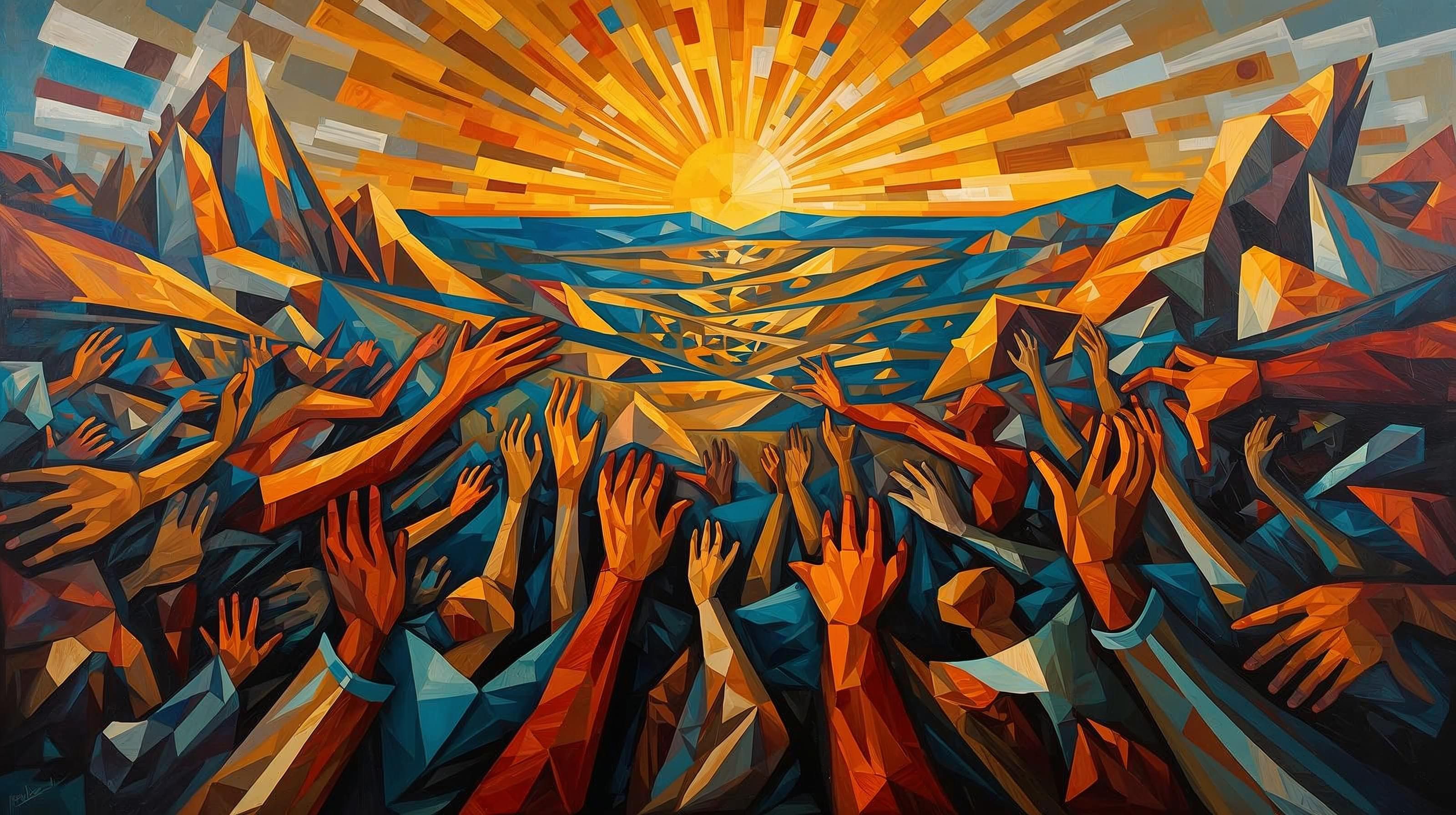
The Confluence of Art and Media: How Art Will Meet The Moment

By Chiara Luz

This site is a holistic media endeavor. Soon, it will be opened up to even more minds and opinions. That is not only how community meets the moment, but art. Art and media are two conjoined halves in my opinion. They function best when they’re interdependent. In our politically charged society we have the opportunity to mine the fields for problems and see where art can tell a different story and advance a better future.

In our politically charged society, we have the opportunity to mine the landscape for problems and explore where art can tell new stories. I taught a workshop on technology and art for the Women’s Caucus for Art a couple of years ago. I am an advocate for digital tools, artificial intelligence, and digital art and sales. I believe there are not only creative, but fiscal, opportunities available within this genre.

Traditional Art Practices


While in-person engagement with art is increasing and traditional forms remain a mainstay of the status quo, the digital world is still evolving. There is as much possibility there as the mind can imagine, and I champion it. Throughout history, art has always faced attack. Artists are close to the Creator —they bring forth the unseen. That is a great deal of power.

So will art survive the moment with integrity and dignity? Of course they will. They are the moment.


It’s also comforting to know that artists still retain control over what they make and how they choose to say it. Artists are needed. Art is the baseline of all innovation, while words shape the language around it. Together, they form the rhetorical world-building pillars of society.


If I had a question, it would be this: how will art rise to the occasion? How will it shape new narratives? Through UNESCO we can study cultural globally and how to preserve it, yet what arw futurists envisioning now? We have spent a fair amount of time uncovering problems and successfully answering some of them. How do we take it a step further while building our own magical society? That is the power of art. I will always be a believer in the small steps. The small details. The small wins.

I believe in each brick that carefullt builds out our daily dreams and lives.

Support the national arts, here.

Posted on — Leave a comment

BirdSEED: Your Path to Affordable Homeownership

I want you to have your dreams. I want to show you that there are tangible ways to obtain them. When this site evolved a few years ago, the tagline was information is access. It still is. Here is another piece of the puzzle so you can rest your head in your own space. You can be proud of yourself and your children can be proud of you. You can do this!

When you’ve been researching housing initiatives for a while, you learn to spot the difference between programs that simply sound good and those that actually shift the landscape. BirdSEED is one of the rare ones that does the latter. 

This isn’t just another down‑payment assistance program. It’s a grant rooted in reparative justice—a direct acknowledgment that generations of discriminatory housing policies created real harm, and that real repair requires more than words. The call for restoration was made and a proram like BirdSEED  answered. BirdSEED steps into that gap with tangible support for families who have been historically shut out of homeownership. 

Why BirdSEED Matters 

If you’ve ever tried to buy a home, or walked alongside someone who has, you know the down payment is often the biggest barrier. BirdSEED offers grants (not loans) to help close that gap. No repayment. No hidden strings. It is support designed to help families finally step into the stability and wealth‑building that homeownership can provide. 

For many, this isn’t just financial help. It’s the difference between renting forever and building generational security. It’s the difference between being pushed out of a neighborhood and having the power to stay rooted. 

What Makes This Program Stand Out 

  • It’s grounded in justice, not charity. 
  • It acknowledges historical harm and responds with real resources. 
  • It’s accessible, with a clear mission and straightforward application process. 
  • It’s designed to repair, not just assist. 

I am a believer that a big part of the American dream is stability, and home ownership is a big part of that picture. There are stories of women becoming widows and finding out they no longer own their homes due to property taxes or title loss or through divorce. Some people simply want a better way to raise their families and to give them a small something. This is it. I have been around for a long time, and I can tell you that programs like this don’t come around often. And when they do, they deserve to be shared widely. Act now and keep your ears to the ground and your eyes open. Your justice is yours to pursue. If you don’t pay attention, I believe that some of these opportunities will be off the table. You don’t want that. You want to give your family the most invaluable thing going—stability.  

How You Can Take Action 

If you or someone you know has been dreaming of homeownership but struggling to cross that financial threshold, take a moment to explore BirdSEED. Share it with your networks. Post it in your group chats. Mention it at work. These are the kinds of resources that change lives when they reach the right people. 

Justice grows when we pass the seeds along.  I am a huge supporter of non-profits that actually do things and are committed to making a real impact.

Additionally, Investopedia summarized some benefits for new homeowners and here are some things found on the federal level that should be of interest to you. Remember, to win is to be smart, knowledgeable, and keeping it simple. Good luck. I have mentioned before that our state has quite a few programs and anything that you do not qualify today–keep trying ladies.


,


Posted on — Leave a comment

How I Stay Focused on Daily Goals As A Busy Mom

a woman in brown shirt typing on her laptop while sitting beside her kids

Most mornings I wake up with a plan. I tell myself that today I will stay focused, stay calm, and stay on track. Then the day actually begins. Someone needs breakfast, someone else can’t find their shoes, the laundry is giving me side‑eye, and suddenly my goals feel like a distant memory. If that sounds familiar, you’re in good company.

Over time I’ve learned that staying on target with daily goals is less about having a perfect routine and more about finding small ways to support myself through the chaos.

a woman in brown shirt typing on her laptop while sitting beside her kids
Photo by Jep Gambardella on Pexels.com
I Keep My Goals Simple

I used to write long lists that looked impressive but never got done. Now I pick three things that truly matter. When I keep it simple, I actually finish what I start, and that feels so much better than staring at a list that grows faster than I can check things off.

I Break Big Tasks Into Bite‑Sized Pieces

If something feels overwhelming, I chop it into tiny steps. Instead of “clean the house,” I’ll focus on “clear the kitchen counter.” Small wins add up, and they give me the momentum I need to keep going. Another tip is to set a timer for 15 minutes and spot clean. You’ll be amazed at what you get done knowing that you only have 15 minutes to do it.

I Lean on Routines

Routines save my sanity. They take the guesswork out of the day and help me stay grounded. Even a short morning ritual helps me feel like I’m steering the ship instead of being tossed around by the waves. My latest endeavor is working out with the Daily Burn app. I scored a membership, and I am looking to break up my workouts in 20-minute intervals. I do 20 minutes in the morning and then 20-minutes in the evening. My daughter keeps me on track. She is like a mini assistant. Daily Burn is also on Amazon Prime. You guys know I love my Amazon Prime and I just got a residual payout, and I am even more encouraged to get new books on Amazon. We love Amazon. It has everything for the indie employee and future entrepreneur.

I Protect My Focus

Distractions are everywhere. If I don’t set boundaries, my attention gets pulled in a hundred directions. I’ve started using short focus sessions where I silence notifications and give myself permission to concentrate on one thing. It’s amazing how much smoother the day feels when I do this. I can get distracted pretty easily when the ideas begin to kick in, but with hardcore focus, I stay determined.

I Celebrate the Small Stuff

Moms are great at cheering for everyone else, but we forget to cheer for ourselves. I’ve started acknowledging my own progress, even if it’s tiny. A little celebration at the end of the day reminds me that I’m moving forward, even when the day felt messy. My personal mantra is to live to fight another day.

I Stay Flexible

Life with kids rarely goes according to plan. I’ve learned to adjust without beating myself up. Flexibility keeps me consistent because it lets me adapt instead of feeling like I failed. I just tell myself– you will live to fight another day. How do you stay on track?


Posted on — Leave a comment

Why Freedom In The Arts And Artistic Expression Matters

By Chiara Luz Atoyebi

Throughout history, the arts have thrived most powerfully when artists are free to speak, challenge, and imagine without constraint. From ancient playwrights questioning authority in public forums, to Renaissance painters pushing against religious orthodoxy, to modern musicians and performers confronting social and political realities, artistic freedom has always been inseparable from cultural progress. When artists lose that freedom, society loses a vital mirror and a vital conscience. However, throughout time art has been and still is used to maintain the status quo while operating under the guise of creative expression. We may ask creative for who?


Art is not meant to be comfortable or purely transactional. It is meant to explore human complexity, to provoke empathy, and to ask difficult questions. Yet again and again, artists have found themselves navigating institutional, financial, or political pressures that threaten to silence or narrow their voices. History reminds us that when creative expression is constrained whether by censorship, rigid bureaucracy, or ideological agendas that the result is not stability, but stagnation.

The Washington National Opera

Opera, like all art forms, depends on risk: emotional, creative, and financial. When systems prioritize control or predictability over experimentation and trust in artists, the art itself suffers. The Washington National Opera’s choice to seek change and independence is not simply a logistical shift, but possibly a statement about preserving space for artistic voices to evolve on their own terms.

It’s also fair to note that sales and sponsorship had been declining for over a year. It’s hard to tell if this is a business decision or one due to creative differences–or both. For now the new location of the Washington National Opera is currently up in the air.

This moment is another chapter in a long history of art and freedom of expression. It reminds us that freedom in the arts is not guaranteed; it must be continually defended.
In protecting artistic freedom, we protect the human voice itself.

Posted on — Leave a comment

Love as Infrastructure: Designing Relationships That Last

Love is an action. So is support. If there is more talk of support instead actually supporting, then we aren’t there you.

When you’re looking for the right partnerships, why not look through the lens of love?


Love asks: Is there respect here?
Is there honesty?
Is there mutual investment and shared accountability?


Through this lens, partnership becomes more than alignment on paper, it becomes trust in practice. It looks like showing up consistently, valuing every player, sharing credit, and counting wins as ours. It’s transparency over performance, clarity over control, and collaboration over competition.


Love doesn’t require perfection, but it does require truth. It lays the cards on the table and builds on facts, not illusions. It feels steady, not transactional. Supportive, not conditional. When viewed this way, the right partnerships feel grounding rather than draining.


Looking through the lens of love means choosing relationships albeit personal, professional, and political, that honor who you are and what you’re building. It’s a builder’s mindset: practical, intentional, and rooted in respect.


And when love is the lens, you don’t have to force alignment, you simply recognize it.

Lastly, be careful who you partner with. All relationships aren’t destined to scale. If you find that others are scaling and your pocketbook is draining–this was a bad option. Some extremely talented people have aligned with some people that used them as a host and they have never been heard from again.

I like to think of Zerrubabel and the building of the second temple of Jerusalem. This was no ordinary call to action, this was a call that would wipe the transgressions of a nation and reap a huge blessing. Zerrubabel had a lot of people pulling on him. Alot of “relationships” but he had to know which ones were destined to scale. When it’s destined to scale the building process may be intimate but the rewards are for the masses.

That’s the goal for 2026.

Posted on — Leave a comment

Barriers Down, Doors Open: Why Now Is the Time to Start Saving Your Refund

I’ve been seeing all of these tiny home deliveries on social media and it got me thinking. What about purchasing land and putting a few on there? It’s a thought. It’s also a thought for you if you are interested. The better thing is that it is an opportunity for equity. You will not have to wait; it all can be yours. If that is too much of an ask, there is also the traditional homebuying route. Just think, you may not be able to leave ten homes behind, but one fabulous one is more than enough. When it boils down, we have no idea what Earth will look like 100 years out, but we have hope for the next thirty.

For years, buying a home felt like it came with a velvet rope and your credit score was the bouncer. But that’s changing. With Fannie Mae moving away from rigid credit score cutoffs and toward a more holistic view of borrowers, one of the biggest barriers to building equity is finally coming down. Translation? Homeownership is starting to look a lot more accessible for everyday people. Even better, each state updates programs that work for even the least among us. Let’s get into it.

This shift is a big deal because equity is one of the most powerful ways families build long-term wealth. When fewer people are automatically locked out by a single number, more buyers get the chance to invest in themselves instead of paying rent year after year. It’s not about “lowering the bar” it’s about recognizing that financial responsibility looks different for everyone, and that strong income, payment history, and savings matter too.

And here’s where your tax refund comes in. That refund isn’t just bonus money; it’s a head start. Whether it becomes part of your down payment, covers closing costs, or boosts your savings reserves, putting it aside now can move you closer to owning a home and building equity sooner than you think. Barriers are being removed, opportunities are opening up, and this could be the year you turn a refund into a foundation for your future.

Tell me are you team tiny house? Or large and forever?

Posted on — Leave a comment

Preserving Gullah Geechee Culture Amid Climate Change

A Fourth of July celebration. St. Helena Island, South Carolina. (1939) Image in the Public Domain

Along the sun-soaked shores, tidal creeks, and marshlands of the southeastern United States, a remarkable culture continues to thrive. Rooted in African traditions and shaped by centuries of resilience, Gullah Geechee culture connects the United States to the broader African diaspora through language, food, music, spirituality, and a deep relationship with the land.

The Gullah Geechee people are descendants of enslaved Africans brought to the Sea Islands and coastal mainland of North Carolina, South Carolina, Georgia, and Florida. Isolated by geography but strengthened by community, they preserved customs, stories, and a Creole language that survived slavery, segregation, and generations of displacement. Today, that legacy faces a new and urgent threat: climate change and land loss.

Recent news coverage has highlighted rising seas and intensifying storms threatening Gullah Geechee communities. But these headlines point to a deeper truth that this is not only an environmental crisis, but a cultural one. What is at stake is a living heritage that deserves recognition and protection on a global scale, including consideration for UNESCO World Heritage status.

Voices from the Community: Why Gullah Geechee Matters

For the Gullah Geechee people, preservation is personal. It lives in the voices of elders, artists, and community leaders who carry traditions passed down for generations.

“I have a passion to sing these songs.”
— Minnie “Gracie” Gadson, elder and singer

Her words reflect the importance of Gullah spirituals — songs that hold history, faith, and survival in their melodies.

“If we don’t know who we are, we’re lost.”
— Emory Campbell, community leader and translator of the New Testament into Gullah

At public meetings and planning forums, advocates often remind us that there is no price tag on cultural heritage. As many have said plainly: without the land, the culture dies. For the Gullah Geechee, land is not just property — it is memory, identity, and continuity.

Why UNESCO World Heritage Status Matters

UNESCO World Heritage recognition would place Gullah Geechee culture alongside some of the world’s most valued cultural landscapes — from the rice terraces of the Philippines to the ancient city of Timbuktu. More importantly, it would provide global acknowledgment, protection, and resources for preservation.

Here’s why that recognition matters:

1. A Living Cultural Landscape

Gullah Geechee culture is not frozen in the past. It lives on through sweetgrass basket weaving, spirituals, storytelling, farming practices, and the Gullah language itself. These traditions are inseparable from the coastal landscapes where they developed — landscapes now threatened by sea-level rise, erosion, and development.

2. Preserving History and Identity

For centuries, Gullah Geechee communities have maintained distinct traditions despite systemic barriers. UNESCO recognition would help ensure these cultural expressions are protected, celebrated, and passed down, not only regionally, but globally.

3. Protecting Sacred Sites and Homelands

World Heritage status often brings international conservation support. This could strengthen local efforts to protect burial grounds, historic neighborhoods, and community gathering spaces that are central to Gullah Geechee history and identity.

The Threat Is Real And Urgent

Climate change is no longer a distant threat in the Lowcountry. Rising seas, stronger storms, and saltwater intrusion are already damaging homes, infrastructure, and ancestral lands. As shorelines disappear, so do the places where culture is practiced, remembered, and taught.

Preserving Gullah Geechee culture means more than protecting artifacts or archives. It means keeping people rooted to their land, ensuring future generations can speak the language, sing the songs, and walk the same beaches their ancestors once did.

Want to Learn More?

Here are three places to explore Gullah Geechee history and preservation efforts:

  • Gullah Geechee Cultural Heritage Corridor
    The official portal for programs, oral histories, and cultural events stretching from North Carolina to Florida.
  • Gullah Geechee Culture Initiative
    A community-driven organization sharing insights into preservation efforts, particularly on Sapelo Island.
  • Penn Center (St. Helena Island, SC)
    One of the oldest institutions dedicated to Gullah Geechee education, culture, and heritage preservation.

A Global Heritage Worth Protecting

Gullah Geechee culture is a testament to resilience, creativity, and survival against extraordinary odds. Recognizing it through UNESCO World Heritage status is not simply an honor — it is a statement of values. It affirms that the stories, traditions, and knowledge of the Gullah Geechee people are not only central to American history, but vital to the heritage of all humanity.

Protecting this culture today ensures that future generations will still hear the spirituals, speak the language, weave the baskets, and remain rooted in the land that has sustained Gullah Geechee communities for centuries.


Posted on — Leave a comment

The Year of Establishment

Image by Generative AI

To Establish or Establish

As I step into a new year, the idea of establishing a new way of living, thinking, and moving in our ever-shifting world feels both daunting and exhilarating. The world around us is in constant flux, with changes happening at an unprecedented pace. In such times, establishing a firm foundation in our lives becomes crucial. This year, I aim to explore what it means to create a life rooted in stability, while also considering the dynamic nature of scaling which is a concept often associated with rapid growth and expansion.

Establishing vs. Scaling: A Delicate Balance

The word “establish” resonates with a sense of permanence and solidity. It suggests planting roots, creating a foundation, and building something that can withstand the test of time. Establishing a new way of living means consciously choosing values and practices that ground us, even as the world around us continues to evolve. It’s about finding what truly matters and nurturing those aspects, allowing them to flourish and provide us with a sense of stability.

On the other hand, “scaling” is often associated with speed and agility. It implies quick growth, adaptability, and the ability to expand rapidly. In our fast-paced world, scaling is essential for staying relevant and seizing opportunities. However, scaling without a solid foundation can lead to instability. Therefore, it’s important to strike a delicate balance between the two: establishing a core that can support growth, while remaining flexible enough to adapt to change.

Embracing Change with Intention

As we embark on this journey of establishing a new way of living, it’s important to embrace change with intention. This means being mindful of the shifts happening around us and within us, and consciously choosing how we respond. It involves cultivating resilience, adaptability, and a willingness to learn and unlearn as necessary.

To do this, we can start by examining our current habits and routines. Are they serving us well, or do they need to be re-evaluated in light of new circumstances? Are we holding onto outdated beliefs or practices that no longer align with our values? By asking these questions, we can begin to make intentional changes that support our growth and well-being.

Setting Goals for a Grounded Future

This year, my goal is to establish a life that is both rooted and dynamic. I aim to cultivate practices that provide stability and nurture my core values while remaining open to the possibilities that change brings. By doing so, I hope to create a life that feels both grounded and expansive. A life that is resilient in the face of uncertainty, and full of potential.

As we navigate this new year, let’s consider what it means to establish a life that is both deeply rooted and capable of growth. By finding the balance between establishing and scaling, we can create a future that is both stable and adaptable, providing us with the strength and flexibility to thrive in a shifting world.

If I had to choose a world I want to leave my children, I would always think about things being firmly rooted and established. It’s possibly the only way to make it last forever. How will you plant your flag? I hope it is not fleeting.