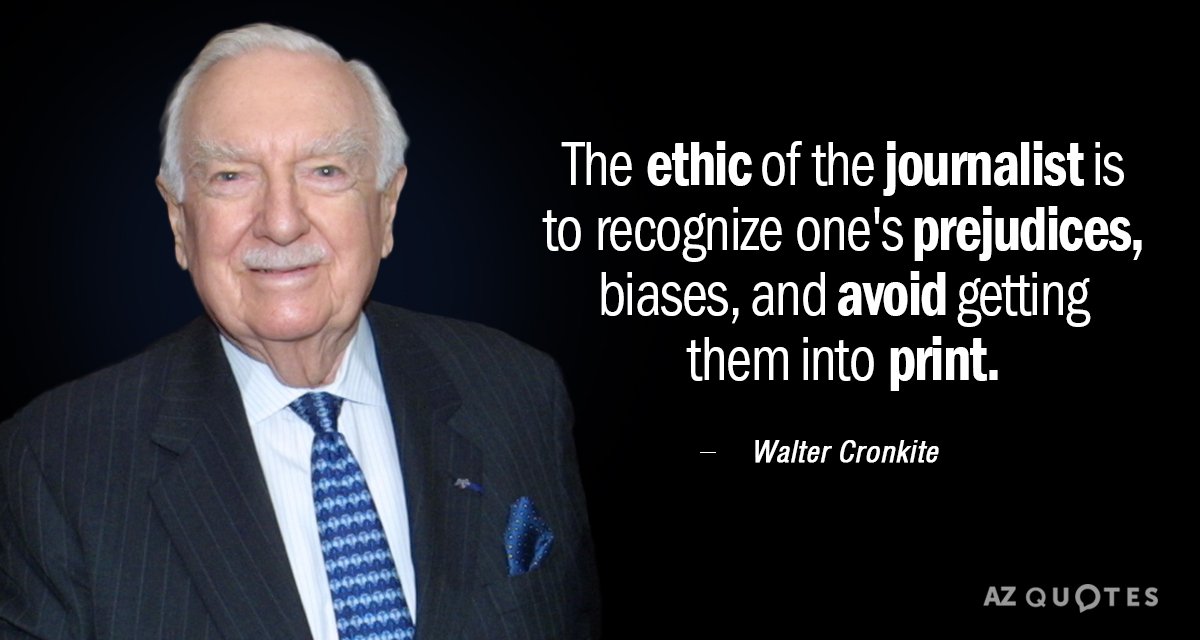
A lot of people are up in arms about the Washington Post’s recent decision to not endorse a political candidate. However, I have to admit, I never liked the idea of mainstream media endorsing candidates, due to its sway over the masses. Malcolm X spoke about this power of the media to make the “innocent guilty and to make the guilty innocent.”
Now, in fairness, we depend on the news media to hold themselves to a high standard of journalistic integrity. But, with money as a strong influence behind the scenes, many wonder if that’s possible. Especially when there are bills to be paid and doors that need to be kept open for employees. But we are not ignorant of the power of media in all its forms. I am very familiar with the power of influence and the effect it can have on one’s life. I watched one influencer for ten years straight. She was mom and she had several failed relationships and she was always chasing a dream and a dollar. She was very beautiful, very vulnerable, and a stay at home mom like me at the time. I resonated with each crying spell and homemade fried chicken enchilada. But, the more I watched her, the more my life mirrored hers. I was slowly becoming a volatile red-lipped mess yelling at my kids to clean, and dreaming of dreams that I wasn’t working towards.
That is the power of influence and the reason I pay more attention to what I consume. You should too. It’s not easy, but it’s worth it. Remember, not only are we who they say we are, but we become what we focus on. It’s the reason I thought long and hard about the importance of sharing the problems, but highlighting the solutions of our world.
Plato once said that, “those that are able to see beyond the shadows and the lies of their culture, will never be understood, let alone believed by the masses.”
I have personal experience with being ahead of my time. It kind of forces you into a corner or the outskirts of your social circle. No one has the time or the capacity to think too deeply, too long, or too hard–and it’s an exhausting endeavor to be believed. But, I feel that change is coming. Who other than the news media, the most powerful entity in the world, should bare the responsibility of being factual and neutral? We are reliant on those overseeing our information to be fair, just, non-biased and balanced. Now, the people who work at institutions have opinions and they should, but they shouldn’t make it to the media.
“One of the reasons that we are in a free speech battle and many other societal battles at this time is because we have given freedom to the masses without parameters and ethics”–Luz
Yet when you think about the press and why people start them up, (myself included) it happens because you feel either misrepresented or overlooked. We do this because of those words imparted by Plato and Malcolm X–we need control and representation! You may feel that major outlets aren’t covering your issues. That’s a fair assessment as well. But, one of the reasons that we are in a free speech battle and many other societal battles at this time is because we have given freedom to the masses without parameters and ethics. I am largely speaking in the realm of journalism but you get my point.
Therefore in my opinion, major news outlets should not endorse candidates. They should remain objective and allow the people to make their decisions. Now, concerning the onslaught of misinformation administered by citizen journalists, and bloggers focused on entertainment operating with or without ethics, only reinforces the necessity of major news outlets being the standard-bearers of neutrality. In doing so, it serves as a form of checks and balances in the realm of reporting and influence. In my opinion, it was the right thing to do, and strong move for helping skeptical readers regain trust in their information sources.
What do you think? Should mainstream newspapers endorse candidates or lean heavily into religion?
When it comes to African Americans taking control of their lives in any way that appears to reflect autonomy it becomes threatening. People coloring outside of the lines, going off of the beaten path, attempting to live outside of “groupthink” can appear suspect. However, a visionary’s job is to see what is coming and therefore it takes a few discerning individuals to be able to follow the signs of them that believe.
I have been on my spiritual path since the age of twelve. It began to shift into high gear at 13 and every five years thereafter. This last five years has been quite mind blowing in terms of intel and has caused me to finally answer the call by incorporating the wisdom of various interreligious elders with similar experiences as mine.
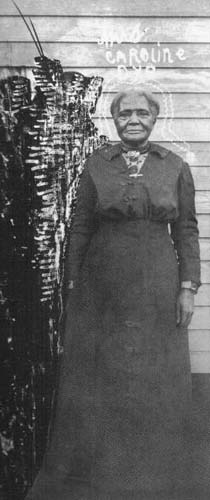
Pictured above is Aunt Caroline Dye. She was a 19th century healer, hoodoo woman, rental property investor, soothsayer, rootworker and conjuror from Arkansas. She was more like a prophet than a fortune teller and she used playing cards to keep her concentration straight. I have mentioned before in my writings, that it was a woman like this, and La Madama, that appeared in my home with a cleaning item ( a broom) pointing to cards on a shelf for me. At the time, I denied them. I was scared. Also, I felt it went against my beliefs. But as I studied the narratives of enslaved people in Puerto Rico, the Caribbean, the Sea Islands of America, Virginia, and the Carolinas–my people–we were the medicine women. We were the people with the answers. The people you don’t touch, even to this day. The day I touched my playing cards for myself, the sky looked brighter.
Since then, I have come into a oneness of self. I didn’t need to be “taught,” everything simply came to me. That’s the spirit of my heritage I am most proud of and a large part of what continues to change my countenance. I also believe that we need to be open spiritually and grounded in morality in order to discern and perceive resources and opportunities correctly. If not, we will continue to spin the wheel as we have always done. The salt of the Earth has produced many fruits but has eaten none and it’s time that has changed.
I love to travel and live in other countries. But there is no place like home. There is no place like America. As Americans, we are in the best place for opportunity. We are in the ripest season to rewrite and reshare all of the international dishes and cuisines at the table of opportunity and narrative history. The opportunity is here and the harvest is here. But, many of us are looking at the food and we can’t eat it. We can’t pick it up. We need to be reeducated and things need to be paced out. But first we have to clear our blocks and break our binds–daily. Every single day. That is why forgiveness is instant but healing takes time.
Although this work is not easy it is not necessarily arduous and you can have a good time doing it with family, culture and traditions. Remember these quotes by Mary Church Terrell and John F. Kennedy Jr.: “Lifting As We Climb” and “One person can make a difference, everyone should try.” Yes, that’s how I see it sometimes.
The Conjure Woman, by Charles W. Chestnutt is an interesting read. One that could almost echo todays societal voices.
The ancestors don’t desire for me to be as earthy as they were, but they do want me to help people as they did. Aunt Caroline drew people from all races to her seeking her wisdom and council. Many from over 400 miles away. I already get requests. Many more formal than I did in the past, and I like to imagine Aunt Caroline and many others watching over me.
Daily writing prompt
What aspects of your cultural heritage are you most proud of or interested in?
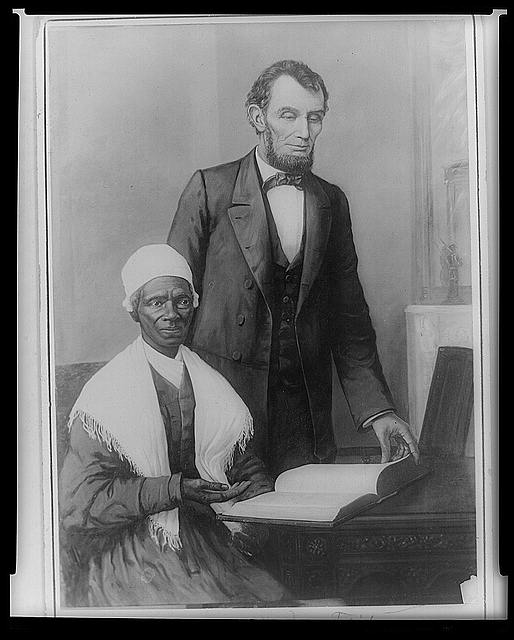
A. Lincoln showing Sojourner Truth the Bible presented by colored people of Baltimore, Executive Mansion, Washington, D.C. ca. 1893. Photograph.
“My name was Isabella; but when I left the house of bondage, I left everything behind. I wa’n’t goin’ to keep nothin’ of Egypt on me, an’ so I went to the Lord an’ asked Him to give me a new name. And the Lord gave me Sojourner, because I was to travel up an’ down the land, showing the people their sins, an’ bein’ a sign unto them. Afterwards I told the Lord I wanted another name, ‘cause everybody else had two names; and the Lord gave me Truth, because I was to declare the truth to the people.” (Harriet Beecher Stowe, “Sojourner Truth, the Libyan Sibyl,” Atlantic Monthly Apr. 1863, 478)
Sojourner Truth, also known as Isabella Baumfree, died on November 26, 2022. Her death had me thinking about the first time I heard her famous speech, “Aint I A Woman.” The interesting thing about history and conversations surrounding memory–is the grey area within the interpretation. For me, nothing can be interpreted fully without taking into account an individual’s sense of self and the psychological perspectives of the community at that time.
Historians have compared and proven the validity of different versions of Truth’s famous speech. Although there was no speech transcript during the convention, her remarks were recounted by abolitionists of the time. Truthfully, how they accurately created two full and different speeches from memory is impressive to me. Perhaps they took notes? Admittedly, something feels incomplete surrounding the information, and I will have to continue my research of the convention.
However, my initial interpretation of the speech was that she spoke on behalf of her race and on aspects of her womanhood. The reality is that Baumfree was an African woman born into slavery and treated as if she was not a woman in the same way her White counterparts. I often wondered if her laments made subtle jabs at the system and the women around her.
If the injustices of the past mirror the civil unrest and racial sentiments of today, it is understandable that Truth would convey her true feelings at the convention to some degree. In fact, this was a woman bold enough to run away from her enslavement.
Truth coming to the podium and stating Ain’t I Woman, would be a logical question placed towards people that had to be convinced of her humanity and womanhood. Moreover, it would all make logical sense considering the period of The Cult of True Womanhood (1820-1860) which raised White womanhood to virtue and purity, while subjugating Black womanhood to licentious stereotypes.
What if Truth’s baiting with the phrase Ain’t I A Woman, was her way of waking people up to her plight and the Truth of their own.
Woman’s Rights Convention, Akron, Ohio, May 28 and 29, 1851
According to the official transcript of the Ohio Women’s Convention at Akron, that took place in 1851 it was recorded that Sojourner Truth commented on education. The purpose of this convention and several others like it, came on the heels of the 1848 Seneca Falls Convention, which fought for women’s social, religious and civil rights. Elizabeth Cady Stanton opened the convention with these words:
“We are assembled to protest against a form of government, existing without the consent of the governed—to declare our right to be free as man is free, to be represented in the government which we are taxed to support, to have such disgraceful laws as give man the power to chastise and imprison his wife, to take the wages which she earns, the property which she inherits, and, in case of separation, the children of her love.” –Elizabeth Cady Stanton, Seneca Falls Convention 1848
Stanton, Elizabeth Cady. Elizabeth Cady Stanton Papers: Miscellany, -1946; Biographical data. – 1946, 1840. Manuscript/Mixed Material.
The need to fight for women’s rights were agreed upon by all women. The only question was who would obtain the rights first. Looking at history and reading the thoughts of the women in attendance at the time, you understand the importance of accepting all people today. If not, you subject them to inhumanity.
You can read the transcript from the convention on the Library of Congress website here. It’ s very interesting and delivers a litany of obvious reasons and examples of a woman’s right to equality, her wages, and her inherited property.
From The Sojourner Truth Project, you can compare the two speeches for yourself. Given the times, what do you think Sojourner meant? Which speech feels true to you?
Marius Robinson’s transcription: Published June 21, 1851 in the The Anti-Slavery Bugle
The oldest account of Truth’s speech that provides more than a passing mention of it was published by Marius Robinson on June 21, 1851 in the Salem Anti‐Slavery Bugle, a few weeks after the speech was given. This version was not the first published account of the Akron speech, but rather the first attempt to convey what Sojourner Truth said in full.
May I say a few words? I want to say a few words about this matter.
I am a woman’s rights.
(a) I have as much muscle as any man, and can do as much work as any man.
(b) I have plowed and reaped and husked and chopped and mowed, and can any man do more than that?
I have heard much about the sexes being equal; I can carry as much as any man, and can (c) eat as much too, if (d) I can get it.
I am as strong as any man that is now.
As for intellect, all I can say is, (e) if women have a pint and man a quart – why can’t she have her little pint full?
You need not be afraid to give us our rights for fear we will take too much, for we cant take more than our pint’ll hold.
The poor men seem to be all in confusion, and dont know what to do.
Why children, if you have woman’s rights, give it to her and you will feel better.
You will have your own rights, and they wont be so much trouble.
I cant read, but I can hear.
I have heard the bible and have learned that Eve caused man to sin.
Well if woman upset the world, do give her a chance to set it right side up again.
The Lady has spoken about Jesus, how he never spurned woman from him, and she was right.
When Lazarus died, Mary and Martha came to him with faith and love and besought him to raise their brother.
And Jesus wept – and Lazarus came forth.
And how came Jesus into the world?
(f) Through God who created him and woman who bore him.
(g)Man, where is your part?
But the women are coming up blessed be God and a few of the men are coming up with them.
But man is in a tight place, the poor slave is on him, woman is coming on him, and he is surely between-a hawk and a buzzard.
Frances Gage’s inacurate version: 23 April 1863 issue of the New York Independent
The most common yet inaccurate rendering of Truth’s speech—the one that introduced the famous phrase “Ar’n’t I a woman?”—was constructed by Frances Dana Gage, nearly twelve years after the speech was given by Sojourner at the Akron conference. Gage’s version first appeared in the New York Independent on April 23, 1863.
Well, chillen, whar dar’s so much racket dar must be som’ting out o’kilter.
I tink dat, ’twixt de niggers of de South and de women at de Norf, all a-talking ’bout rights, de white men will be in a fix pretty soon.
But what’s all this here talking ’bout?
Dat man ober dar say dat women needs to be helped into carriages, and lifted over ditches, and to have de best place eberywhar.
Nobody eber helps me into carriages or ober mud-puddles, or gives me any best place.
-And ar’n’t I a woman?
Look at me.
(a) Look at my arm.
(b) I have plowed and planted and gathered into barns, and no man could head me.
-and ar’n’t I a woman?
I could work as much as (c) eat as much as a man, (when (d) I could get it,) and bear de lash as well
-and ar’n’t I a woman?
I have borne thirteen chillen, and seen ’em mos’ all sold off into slavery, and when I cried out with a mother’s grief, none but Jesus heard
-and ar’n’t I a woman?
Den dey talks ’bout dis ting in de head.
What dis dey call it?
Dat’s it, honey.
What’s dat got to do with women’s rights or niggers’ rights?
(e) If my cup won’t hold but a pint and yourn holds a quart, wouldn’t ye be mean not to let me have a little half-measure full?
Den dat little man in black dar, he say women can’t have as much rights as man ’cause Christ wa’n’t a woman.
Whar did your Christ come from?
Whar did your Christ come from?
(f) From God and a woman.
(g)Man had nothing to do with him.
If de fust woman God ever made was strong enough to turn de world upside down all her one lone, all dese togeder ought to be able to turn it back and git it right side up again, and now dey is asking to, de men better let ’em.
Bleeged to ye for hearin’ on me, and now ole Sojourner ha’n’t got nothin’ more to say.





 link.medium.com/ftkXni5gUwb