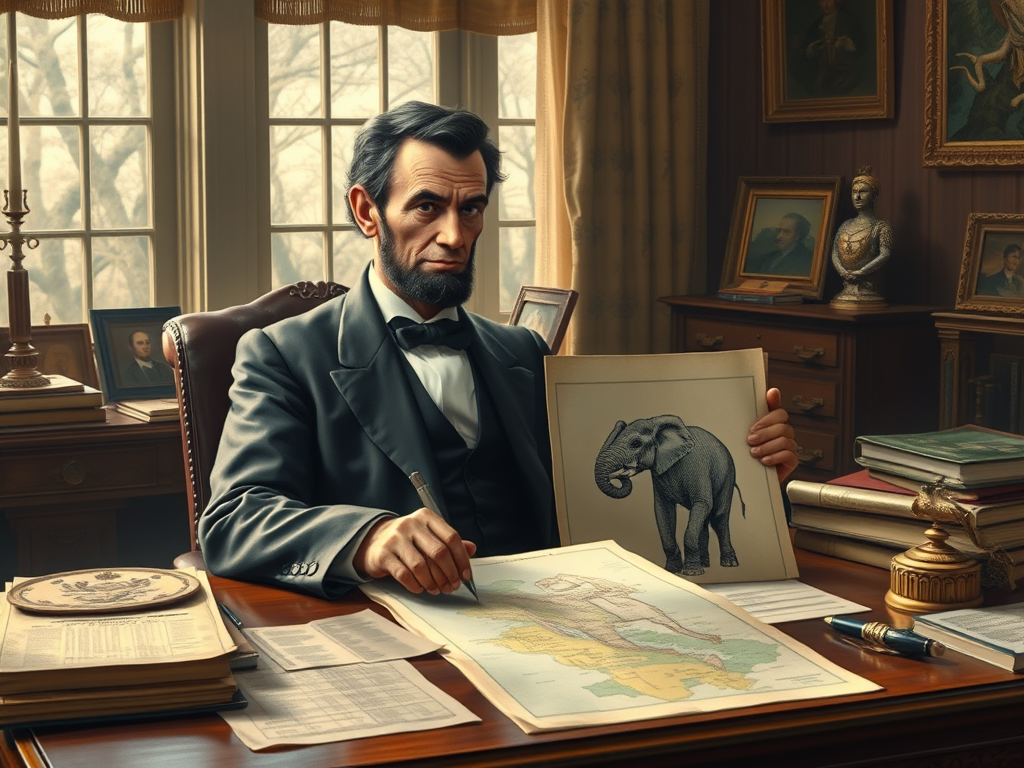

“Abraham Lincoln, artist’s impression, lithograph, circa 1877,” House Divided: The Civil War Research Engine at Dickinson College, https://hd.housedivided.dickinson.edu/node/40378
In the winter of 1862, as the American Civil War ground on with grim uncertainty, President Abraham Lincoln received one of the most unexpected diplomatic proposals in U.S. history: an offer of war elephants.
The offer came from King Mongkut of Siam (modern-day Thailand), a forward-thinking monarch eager to engage with Western powers and demonstrate his kingdom’s relevance in a rapidly modernizing world. In a formal letter written in 1861, Mongkut proposed sending a number of trained elephants to the United States to assist the Union war effort against the Confederacy.
The image is almost surreal, elephants lumbering across American battlefields, but the offer was serious, thoughtful, and rooted in genuine goodwill.

A military elephantnamed Lizzie (elephant) during World War I image in the Public Domain
A World Watching America’s War
To understand the moment, it helps to remember that the Civil War was not just a domestic affair. European and Asian powers watched closely, weighing how the conflict might reshape global politics, trade, and influence. For Siam, maintaining friendly relations with powerful Western nations was a strategic priority. Mongkut, well-educated in European science and diplomacy, saw engagement as a way to preserve Siam’s independence in an age of colonial expansion.
In Southeast Asia, elephants had long been used for transport, engineering, intimidation, and warfare. To Mongkut, offering elephants was the equivalent of offering valuable military hardware, a practical contribution rather than a symbolic gift.
There was also a lag in global communication. By the time the letter arrived in Washington, it was already outdated. Mongkut had addressed it to President James Buchanan, unaware that Abraham Lincoln had been inaugurated in March 1861. The slow pace of 19th-century diplomacy meant good intentions sometimes arrived wrapped in obsolete assumptions.
Lincoln’s Measured Reply
Lincoln responded on February 3, 1862, with characteristic courtesy and clarity. He thanked the King of Siam for his generosity and friendly spirit, acknowledging the value of elephants in their native regions. But he politely declined the offer. Below is the exact letter from Lincoln via the House Divided Project:
February 3, 1862
Abraham Lincoln,
President of the United States of America.
To His Majesty Somdetch Phra Paramendr Maha Mongut,
King of Siam,
&c., &c.
Great and Good Friend: I have received Your Majesty’s two letters of the date of February 14th., 1861.
I have also received in good condition the royal gifts which accompanied those letters,—namely, a sword of costly materials and exquisite workmanship; a photographic likeness of Your Majesty and of Your Majesty’s beloved daughter; and also two elephants’ tusks of length and magnitude such as indicate that they could have belonged only to an animal which was a native of Siam.
Your Majesty’s letters show an understanding that our laws forbid the President from receiving these rich presents as personal treasures. They are therefore accepted in accordance with Your Majesty’s desire as tokens of your good will and friendship for the American People. Congress being now in session at this capital, I have had great pleasure in making known to them this manifestation of Your Majesty’s munificence and kind consideration.
Under their directions the gifts will be placed among the archives of the Government, where they will remain perpetually as tokens of mutual esteem and pacific dispositions more honorable to both nations than any trophies of conquest could be.
I appreciate most highly Your Majesty’s tender of good offices in forwarding to this Government a stock from which a supply of elephants might be raised on our own soil. This Government would not hesitate to avail itself of so generous an offer if the object were one which could be made practically useful in the present condition of the United States.
Our political jurisdiction, however, does not reach a latitude so low as to favor the multiplication of the elephant, and steam on land, as well as on water, has been our best and most efficient agent of transportation in internal commerce.
I shall have occasion at no distant day to transmit to Your Majesty some token of indication of the high sense which this Government entertains of Your Majesty’s friendship.
Meantime, wishing for Your Majesty a long and happy life, and for the generous and emulous People of Siam the highest possible prosperity, I commend both to the blessing of Almighty God.
Your Good Friend,
ABRAHAM LINCOLN.
Washington, February 3, 1862.
By the President:
WILLIAM H. SEWARD, Secretary of State.
“Abraham Lincoln to the King of Siam, February 3, 1862,” House Divided: The Civil War Research Engine at Dickinson College, https://hd.housedivided.dickinson.edu/node/40508.
Why the Offer Mattered
No elephants ever crossed the Pacific, but the episode endures because it reveals several important truths about the era.
First, it highlights how globally connected the mid-19th century already was. News traveled slowly, but it traveled far, and events in America resonated in royal courts half a world away.
Second, despite early Union defeats and widespread uncertainty, Lincoln never believed the war would be decided by exotic weapons or foreign intervention. Victory would come through mobilization, industry, manpower, and time.
Finally, the exchange humanizes history. Beneath the grand narratives of battles and strategy, there are moments of sincere misunderstanding, cultural difference, and unexpected generosity. A king offered what he knew to be valuable. A president declined with grace.
A Curious Footnote, A Connected World
Today, Lincoln’s reply is preserved among his papers and stands as one of the more curious footnotes in American military history. It reminds us that even in the darkest chapters of war, diplomacy could still be polite, imaginative and occasionally strange.
Sometimes history isn’t just about armies and battles. Sometimes it’s about a letter, a king, and a handful of elephants that never were.