Saint Josephine Bakhita stands as a quiet but powerful witness to survival, dignity, and hope. She is the patron saint of people who have been trafficked, abused, and exploited—especially those subjected to slavery and sexual violence. Her life reminds us that sanctity can rise even from the deepest suffering, and that no human being is ever beyond redemption or worth.
From Enslavement to Freedom
Josephine Bakhita was born around 1869 in Darfur, Sudan. As a young child, she was kidnapped by slave traders, torn from her family, and sold multiple times. During her captivity, Bakhita endured brutal physical abuse, psychological trauma, and repeated violations of her body and dignity—experiences that closely mirror what many survivors of sex trafficking face today.
Her captors gave her the name Bakhita, meaning “the fortunate one,” a cruel irony given the horrors she endured. Over time, she was forced to forget her birth name and even her native language, a devastating loss of identity that is common among trafficked victims.
St. Josephine Bakhita for kids
Encountering God in the Midst of Trauma
Eventually, Bakhita was brought to Italy, where slavery was no longer legal. For the first time, she encountered kindness without violence and authority without abuse. It was there that she learned about Christianity and came to understand God not as another master, but as a loving presence who had been with her even in her suffering.
Bakhita later said that if she met her captors again, she would kneel and kiss their hands—not because what they did was acceptable, but because, through her suffering, she came to know God. This radical forgiveness does not erase injustice; rather, it reveals a profound spiritual freedom that no chains could destroy.
Why She Is the Patron Saint of Trafficking Survivors
Saint Josephine Bakhita is the patron saint of victims of human trafficking because she lived their reality. Her sainthood does not romanticize suffering; it validates it. She represents:
Survivors who have been silenced
Bodies treated as commodities
Lives fractured by exploitation
The long, painful journey toward healing
Her life tells survivors: You are not defined by what was done to you. Your dignity is intact. Your story is not over.
A Saint for Our Time
Human trafficking is not a problem of the past—it is a global crisis happening in plain sight. Bakhita’s story urges us not to look away. She challenges us to listen to survivors, to support organizations that protect the vulnerable, and to confront systems that allow exploitation to thrive.
Her holiness was not forged in comfort, but in endurance, compassion, and love. In a world that often reduces trafficked persons to statistics, Saint Bakhita restores the human face.
A Prayerful Call to Action
Honoring Saint Josephine Bakhita means more than remembering her story. It means committing ourselves to justice, mercy, and solidarity with those who are still trapped in cycles of exploitation. Whether through advocacy, education, prayer, or direct service, each of us can play a role in ending trafficking and supporting survivors.
Saint Josephine Bakhita, patron saint of those who have been trafficked, pray for us—and especially for all who are still waiting to be free.
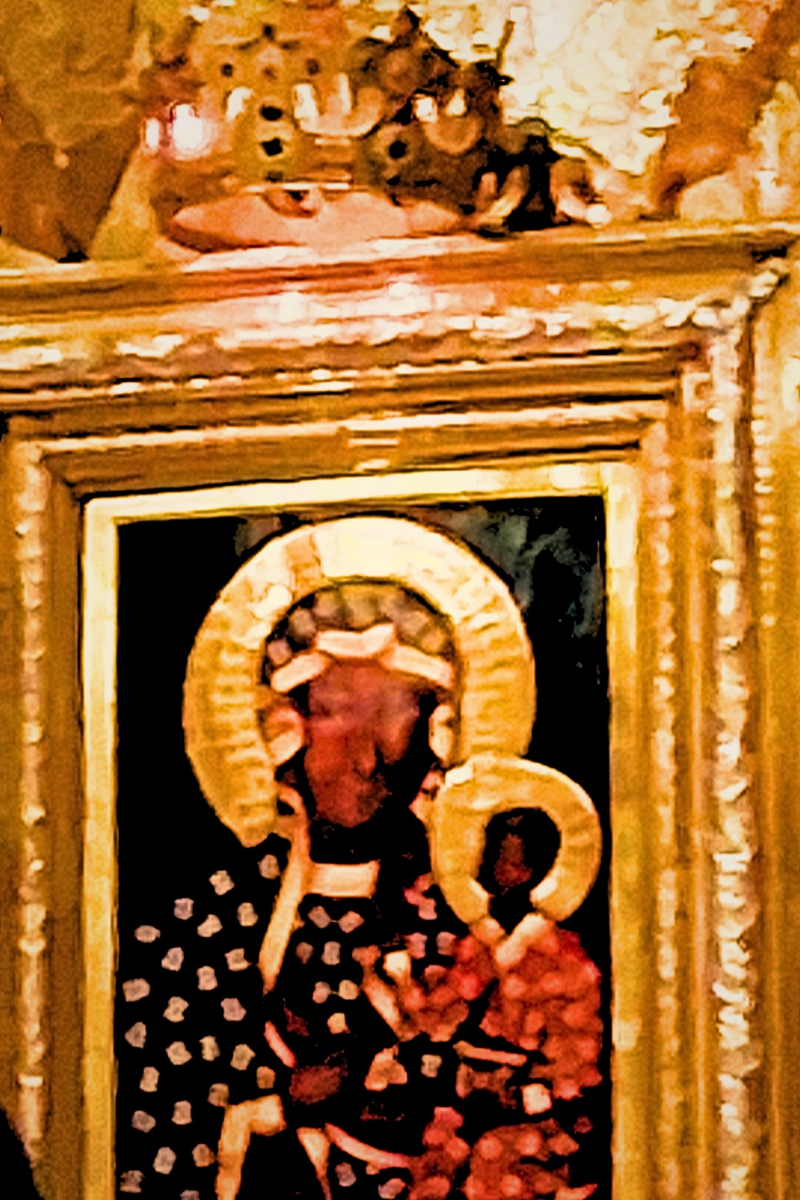
Photo of Our Lady of Czestochowa, Courtesy of Chiara Luz Atoyebi, Washington. DC 2025.
I have seen a few signs and wonders at The Basilica in DC, and it always happens with exactly one witness. This past Sunday when we were leaving mass I looked up and saw what appeared to be Our Lady smiling. If you are familiar with this image and iconography it is more somber. But on this day I tapped my son and said, “is she smiling?” he said, “yeah that’s weird.”
I immediately snapped a picture and here it is.
For me it proves the spiritual connection of art in the way that Kandinsky wrote about. Additionallyalso believe that this is a smile of support and pride.
Let me know if you see the smile and what you think. I think it is a good omen for the new year.
My daughter woke up from a dream saying that she had been being bullied by an old man. He thought she didn’t have a family and wanted her to beat box and fight him. He captured her, but she told him that she didn’t want to beat box against him he was an adult. Then she told him she had a family and he let her and her friend go.
In order to understand why this dream is so interesting is to understand a small girl with a big name—Monarch. I always think of her as a gentle hearted champion. When I think of a Monarch transformation comes to mind. I also think about the inheritance that we labor daily to hold on it. The vision of the bully against the child the world thinks is alone is actually a testament to the hidden giant that is planted within us. We have the power to beat our giants. My daughter makes me think of St. Martin de Porres. Like all good things that come from God–they come with a lasting legacy, not a temporal one.
Who is St. Martin De Porres?
St. Martin de Porres lived a life of humble service that continues to inspire Christians today. Born in Lima, Peru, on December 9, 1579, Martin faced hardship from the very beginning. The son of a Spanish nobleman and a freed woman of African and Indigenous descent, he grew up in poverty and experienced discrimination because of his mixed-race heritage. Yet his heart was always turned toward compassion, and that caused him to receive a divine blessing and calling over his life.
He reminds me of the gentle hearted and very wise Pope Leo.
At just 15 years old, he began volunteering with the Dominican friars, taking on the simplest tasks like sweeping floors, washing dishes, and tending the sick. It was while he was working in the infirmary that miracles of instant healing and cures began to manifest.
Eventually, St. Martin had the opportunity to rise in the ranks of the church. However, he chose to continue doing what he was doing. He was also known to give alot of money to the causes of the needy. Much more than he should have based on his position.
St. Martin’s life was marked by extraordinary compassion for the marginalized, the hungry and the suffering. While he was assigned to care for the sick he showed unwavering patience and kindness to all, regardless of race or status. He founded an orphanage, aided the poor. His heart was so open that he even cared for animals, welcoming stray cats and dogs and had a remarkable connection and repoire with many animals. He lived a life of healing, peace, community, and generosity. His life kind of makes you contemplate what a life well lived looks like.
Canonized in 1962 by Pope John XXIII, St. Martin de Porres is the patron saint of people of mixed race, barbers, innkeepers, public health workers, and all who work toward racial harmony and social justice.
In praying with St. Martin, we are reminded that holiness is found in small acts of love offered without pride or expectation.
May his example stir our hearts to serve the least among us, to cross boundaries of prejudice, and to see Christ in every brother and sister we encounter.
“Whoever humbles himself will be exalted.” –Matthew 23:12
Devotional Prayer for St. Martin de Porres
St. Martin de Porres, humble servant of God, teach us to love without condition and to serve without seeking reward.
Help us to see Christ in the poor, the suffering, and the forgotten. Intercede for us, that we may walk in humility, trust in God’s providence, and reflect Christ’s mercy in all we do. Amen.
My personal question is, what does St. Martin’s life show us? What is a life well lived? Why did he choose to stay where he was when he could have had so much more? Eventually, because the light on his life, he broke all the barriers–but he chose to remain set apart. We don’t know of those Dominican Friars he served with. But, we do know of him and that is no accident.